27 February 2007

All around the presence

Sweet Briar Theatre Presentation Makes You Think about the ‘Endgame’
By Jennifer McManamay - SWEET BRIAR COLLEGE
If all you knew about Samuel Beckett’s one-act play “Endgame” was that two characters live in trash cans, you’d think, “Oh. Like Sesame Street.
”But Beckett’s world is not like Sesame Street. It’s the stuff of our worst fears, something gone terribly wrong, something, maybe, that we brought on ourselves.
Sweet Briar Theatre will present “Endgame,” directed by adjunct SBC theater instructor Geoffrey Kershner, at 7:30 p.m. Feb. 15, 16, 17 and 18 in the Babcock Fine Arts Center studio theater. All shows are free, but reservations are suggested and will be accepted beginning Feb. 5 by calling 381-6120 or e-mailing boxoffice@sbc.edu.
The playwright never reveals what caused the death of nature, but nothing lives beyond the walls his four characters inhabit. There is blind, paralyzed Hamm and his servant Clov who cannot sit down, and the garbage can dwellers Nagg and Nell. They are Hamm’s parents. Both are legless and going deaf and blind. All seem vestiges of humankind, and are still decaying.
Writing in the mid-1950s, Beckett might have been alluding to nuclear annihilation. “There was this sense and fear of humanity’s self-destruction,” Kershner said.
Rereading the play’s text in 2006, it struck Kershner that the danger of global warming makes “Endgame” eerily contemporary. The dialogue doesn’t deal with the issue directly, but he believes the resonance between Beckett’s time and ours will start conversations.
“This isn’t a generation that had to duck under their desks. This is a generation that’s dealing with new fears and new issues,” Kershner said. “This is a way to get them talking about it.”
A playwright of the absurdist theater movement, Beckett’s work is abstract, which appeals to Kershner. “To me, his metaphoric approach is a truer reflection of the pain and pleasure of existence than theatrical realism,” he said.
Hamm, played by Mary Susan Sinclair-Kuenning ’09, harangues Clov and the two bicker constantly. Clov (Elizabeth Caldwell ’08) talks of leaving, but where is there to go? The world outside is dead. Clov would kill Hamm, except that Hamm has the combination to the food cupboard.
There is dark humor in the foursome’s awful situations. “Nothing is funnier than unhappiness, I’ll grant you that,” Nell (Eugenia Hannon ’10) tells Nagg (Doug Macleod) before Hamm, angered by their talk, insists that Clov “bottle” them in the trash cans.
Kershner thinks people will take from the play a sense of hopefulness or hopelessness according to their own inclinations. His direction aims for balance. “I’m acknowledging both because I think life has both. If it’s too dark you get depressed and you get it in five minutes,” he said.
For SBC’s production of “Endgame,” Kershner is teaming up with set designer Krista Franco and sound designer Bryce Page. The three are partners in their recently established Endstation Theatre Co.
The show will be in the black box studio theater, a setting that is conducive to the play’s atmosphere, Kershner said. “The performance will happen in and around the audience, with sound throughout the whole space.”
Cheryl Warnock, SBC assistant professor of theater arts and Babcock technical director, will design the lighting. Luna Dellaporte ’08 will take on the costume design.
A pre-show dinner lecture and discussion is planned from 6 to 7 p.m. for the Feb. 15 opening. Speaker Nathan Currier will draw on training he recently attended through Al Gore’s Climate Project to talk about global warming.
The lecture will be in the Johnson Dining Room at Prothro Hall. Dinner prices with a Sweet Briar ID are $5.50 for adults, $2.75 for children ages 3 to 11; and $6.75 for adults, $3.50 for ages 3 to 11 without an ID.
For information, call (434) 381-6120 or e-mail: boxoffice@sbc.edu.

What a Brutal Fucking Movie

The review of Inland Empire, the last David Lynch's movie.
"A corpse is a corpse, of course, of course. And no one can talk to a corpse, of course. Unless, of course, that corpse is brought to you by the famous Mr. David Lynch. In this case the corpse gets up and shuffles away, walking the earth like something out of a Samuel Beckett play directed by George Romero."
THE ALL TEXT HERE.

Familiar or not


Paul Auster Playfully Examines What It Means To Read
By Richard Gaughran - The Daily News Record - Harrisonburg Virginia

To put matters simply, novels come in two varieties. The more familiar creates an alternative reality, allowing us to enter a make-believe world. The less familiar doesn’t necessarily invite us into an alternative world, because it never lets us forget that we’re reading.
In more familiar fiction, it matters only that we play along with the novel’s creator. We strike a deal: make the make-believe believable and we’ll accept, at least while we’re reading, that the fictional world is real.
Writers of this type of fiction can differ widely. They might present domestic dramas, as the Bronte sisters do; recreate history, as Leo Tolstoy does; or concoct a fantasy epic in the manner of J.R.R. Tolkien.
We feel we know the characters in these novels, whether we sympathize with them or not. These are the kinds of works we’re referring to when we say we’re going to "cuddle up with a good book." We may grow in knowledge from reading, and we may feel morally or emotionally invigorated, but we are undoubtedly also escaping.
In the less familiar kind of fiction, we strike a different bargain with the author, one that requires us to assist in the work’s creation. Instead of embracing alternative worlds, we must cope with constant reminders that we are sitting in our chairs, holding a manufactured object, reading words.
These books don’t allow us to get chummy with their characters, because they never insist that the characters are real. We’re less likely to cheer or frown at characters’ actions than to examine our own role as readers.
Most works in this second category have appeared since the First World War, created by writers such as James Joyce, Samuel Beckett and Jorge Luis Borges. These writers can appear difficult, since they never let us relax, keeping both hemispheres of our brains firing.
I offer this bit of pedantry to put into context Paul Auster’s new novel, "Travels in the Scriptorium." As we might guess from the title, this short work is decidedly of the second type. A scriptorium, after all, is a room set aside for the writing or copying of texts. The reference to travels within such a confined space announces irony at the outset.
Auster’s novel presents itself as a report about a man confined to this room. A tiny camera records his actions, and an unnamed narrator seemingly draws on the photographic evidence to construct the old man’s story, without reference to a world beyond the scriptorium, or even to the character’s past, except in fleeting moments, as though the world is a dream the man has had.
The narrator ostensibly has no other information about the man than what the hidden camera reveals: "Who is he? What is he doing here? When did he arrive and how long will he remain? With any luck, time will tell us all. For the moment, our only task is to study the pictures as attentively as we can and refrain from drawing any premature conclusions."
The narrator is being disingenuous, however, since he can’t refrain from immediately giving the character a name, Mr. Blank. He also supplies the character’s thoughts and feelings, which the camera cannot record.
Mr. Blank’s room contains a bed and a desk, on which rest photographs of people he doesn’t recognize. As he stares at the photo of a young woman, however, the name "Anna" floats into his mind, as though he once knew her but has lost his memory. The narrator also notes that pieces of tape have been affixed to objects in the room, each bearing the name of the object. "On the bedside table, for example, the word is TABLE. On the lamp, the word is LAMP."
Mr. Blank cannot determine the nature of his imprisonment, if indeed he is imprisoned. But he notices a manuscript on the desk, and he begins reading. It’s the narrative of a prisoner, someone who has been locked in a cell, from where he has evidently composed his report. We then read along with Mr. Blank, but, like him, we’re interrupted by visitors to the scriptorium, some bringing meals or mysterious colored pills, some asking cryptic questions or delivering veiled instructions.
One such intruder, an ex-policeman named Flood, says he desperately needs to question Mr. Blank about a passage in a novel by someone named Fanshawe. Flood claims that Mr. Blank once wrote a report on Fanshawe, referring to Fanshawe’s novel "Neverland," which describes one of Flood’s dreams. Mr. Blank has no memory of reading this book, but Flood pleads for help, insisting that only a recollection of that dream can restore his identity: "Sometimes I question whether I even exist. Whether I’ve ever existed at all. The dream is my only chance."
Obviously, this sort of cleverness won’t appeal to everyone. It’s probably no coincidence that Auster’s most recent literary endeavor, before this novel, was to edit an edition of Samuel Beckett’s complete works.
Beckett, who would have been 100 in 2006, perfected minimalist, self-referential, highly humorous writing of this type. Auster’s novel pays fitting tribute to a master.

Wait for me

Stripped to the basics
FLC's 'Waiting for Godot' has few decorative elements
By Richard Malcolm Durango Herald

Two men, Vladimir and Estragon, arrive on a stage that is bare but for a rock and a windblown tree, where they wait, wait, and wait some more, for someone named Godot, who never arrives. A New York Times reviewer in 1956 called Samuel Beckett's play "Waiting for Godot" "a mystery wrapped in an enigma."

But don't let the play's 'difficult' reputation put you off, said visiting Beckett scholar Professor Enoch Brader from the University of Michigan, speaking to a packed house at the Fort Lewis College theatre department on Friday night.
Brater spoke before the college's production of "Godot," a play Beckett wrote in French in the late 1940s and translated into English in 1954.
Brater called the play "the most important of the second half of the twentieth century." That's an impressive claim for a play in which almost nothing happens, but there is craft and method to Beckett's absurdity. Writing in the aftermath of World War II, Beckett conjured up a barren stage world in which all the old certainties and beliefs have been demolished, but people still hope, searching for meaning and, perhaps, salvation.

In doing so, Beckett ushered in a new genre of theatre in which complex plots, recognizable characters, and realistic sets were abandoned for a theatre that was stripped to the basics.
Brater described the play as "a compelling dramatic situation with the fewest possible dramatic elements."
Head of Theatre at FLC and director of "Godot," Kathryn Moller, added that she sees in the play "a human drama pared down to its most necessary emotions: expectation, companionship, and hope."
Richard Malcolm is a freelance writer in Durango.

If you go:

"Waiting for Godot" - by Samuel Beckett, plays at 7:30 p.m. on Thursday, Friday and Saturday; $11/$9 staff and seniors/$5 students and children, in the Fort Lewis College Theatre building. It is performed by students Miles Batchelder, Geoff Johnson, Matthew Mount, Josh Becker and Tony Rocco. Set design is by Nathan K. Lee, and lighting design is by Kurt Lancaster.

08 January 2007

Twenty four A's

Contemplating the ridiculous
BY RAVI VYAS / THE HINDU

NOTHINGNESS, emptiness, repetition, boredom, for better or for worse: Samuel Beckett refined these characteristics throughout his literary career. But the result is far from a sadness of content. There is laughter behind the apparent sadness (they are two sides of the same coin in any case) because it is a reflection of the ridiculous human condition: "When you are in the last ditch with your back to the wall, there is nothing left to do but sing." Or, "nothing is funnier than unhappiness...Yes, yes it's the most comical thing in the world." What "nothingness" conceals is the constant contingency as one character asks another in his 1958 play, "Endgame": "We're not beginning to...to...mean something?"

Everything is contingent on something else and to that extent Beckett is "the last modernist", or, if you like, the "first postmodernist". Emptying his books of plot, descriptions, scenes and characters, Beckett is believed to have killed the traditional novel, or else taken it to the crossroads of the modern novel. So, a contemporary critic has said that Beckett will continue to be relevant "as long as people still die". But Salman Rushdie, introducing Beckett's later novels in a new Grove edition issued to mark his centenary this year, takes the opposite — or, life being what it is, perhaps the identical — view: "Those books, whose ostensible subject is death, are in fact books about life". One of the most obscure writers of the last century has suddenly become all things to all people. There is even a book, Beckett and Zen, which isn't a far-fetched connection, come to think of it, because we need to empty our minds to open up one of Beckett's texts to simply hear the words that are there. And figure out what they mean.

Beckett's appeal

Why does every critical writer want to recruit Beckett? What is their eagerness to claim Beckett as one of their own? The clue perhaps lies in Beckett's famous trilogy, Molloy, Malone Dies and The Unnamable on which Beckett's high reputation as a novelist rests. After the tremendous world-wide success of "Waiting for Godot", Beckett has become what he is today: an icon, not just in the popular-cultural sense but in the original meaning of a picture of an existential saint who disliked publicity, gave away his Nobel Prize money, and lived in Spartan rooms across a courtyard from a prison whose inmates he could hear howl.

Increasing relevance

The answer why Beckett has become increasingly relevant lies in the trilogy, which is considered as a critical introduction to his original masterpiece of the theatre, "Waiting for Godot". In these novels, there is little or no dialogue. Malone Dies is a sombre soliloquy in which one or two shadowy characters appear; and in the other two the page is unbroken except for an occasional questionnaire. Place and time are of no importance; towns have peculiar names like "Bally" or "Hole"; the past is murkily remembered, the present non-existent, family ties are few and far between: "She died giving me birth," said Mr MacStern. "I can well believe that," said Mr de Baker. All his characters are deformed or hideous and move in a terrifying atmosphere of rejection, abandonment and guilt.

Molloy begins with Molloy shut away in his dead mother's room, steadily writing. Each week he is visited by a stranger who takes away what he has written and pays him money. What he has written is a long, fruitless odyssey in search of his mother.

Molloy begins crouched in the shadow of a rock watching two men, A and C, approach each other across a plain. One carries a stout stick, the other — or is it the same man? — is followed by a dog. Molloy isn't sure whether they are travellers or mere strollers. The two come together briefly, and then separate:

"Did he not seem rather to have issued from the rampart, after a good dinner, to his dog for a walk, like citizens, dreaming and farting, when the weather is fine? `A' backwards towards town, `C' on by ways he seemed hardly to know."

Here they serve as an image of two ways of going, to be brooded upon as he himself prepares to set out in quest of his mother. But his own journey is less rosy than A's or C's. He has a stiff leg, which makes walking difficult, so he has to go by bicycle, harried by the police and a rowdy mob. The second half of the book is the same story again from the opposite point of view told by Moran, who is a clear-cut, man of action, unlike Molloy who is vague, destitute, helpless, crippled and given to too much logic and reason. But both Molloy and Moran meet the same dead end: Moran finishes as a recluse with Molloy similarly wrecked.

Profound pessimism


Malone Dies takes us further on into the darkness: one voice, less plot, an old narrator who keeps harping, with pride on his impotence. There is peace of total personal negation; nothing remains. In The Unnamable even this begins to fail. If Malone Dies retains some paltry shreds of plot, incident and character because it is an attempt at an ending, there is none of it in The Unnamable because Beckett's pessimism was too profound to allow him to believe that death would be an end or even a relief. Voices would continue beyond the grave, into the "pit" where the Unnamable is fixed.

There is no one way you could read this trilogy; you could do it in several different ways. As he said in his prose masterpiece, Worstward Ho! six years before his death in 1983: "No matter. Try again. Fail again. Fail better."
...
The Beckett Trilogy: Molloy, Malone Dies, The Unnamable (1959), Samuel Beckett, Picador Books, Price £2.95.

Final and Posthumous Works

Most of the short pieces Beckett wrote in later years are a condensation and a refinement of themes he had explored earlier at greater length. The stripping away of inherited “Anglo-Irish exuberance and automatisms” which marked his official passage from English to French never ceased.

The same process continued in his theater—the “theatrical chamber music” in which everything counts: every syllable, every sign, every pause.

“I don’t expect I’ll have any more big ones,” Beckett told a friend in the summer of 1981. And the works did continue to grow shorter. But not necessarily slighter. Like Rembrandt’s smaller drawings, they are monumental miniatures.

Through successive rereading of such works at “Ceiling” and “The Way,” one comes to appreciate the matchless precision of Beckett’s method of composition. He was one of the most skilled practitioners of the craft who ever wrote. His wholly original style, unerringly true, is of the kind that “can come forth by nothing but by prayer and fasting.” Which, freely translated, means by rewriting. There have been other great writers—Marcel Proust, and Louis-Ferdinand CĂ©line—who were obsessive rewriters. But Beckett, a greater craftsman than either, goes a step beyond. His work is fired and purified like molten gold in the crucible. It is not surprising that all of his writing shows a precision, a concentration, and, in the broadest sense of the word, a purity which set him apart from his peers.
FROM "Fathoms From Anywhere" / MORE: Manuscripts & Publications

Faraway launched here

The HRC's Beckett Online: Googling for Godot
BY KATHERINE CATMULL / AUSTIN CHRONICLE


When your Web-wanderings bring you to the Harry Ransom Center's online Samuel Beckett exhibition, you have a choice.
"I can't go on", reads one scrawled line. "I'll go on," reads the other.
Choose the first of these iconic lines from Beckett's novel The Unnamable, and you're promptly thrown back to the page you came from. Choose the second, and you enter "Fathoms From Anywhere: A Samuel Beckett Centenary Exhibition."
The title is taken from a letter Beckett wrote in 1959: "I don't find solitude agonizing, on the contrary. Holes in paper open and take me fathoms from anywhere."
Most avant-garde art looks quaint and time-bound 50 years on. But Beckett's plays and novels remain essentially strange, like visitors from a cultural future. Beckett was so far ahead of his time that we haven't yet caught up with him, and his work retains unnerving power.
Launched on the centenary of Beckett's birth, April 13, 2006, the exhibit will be kept online "in perpetuity," says curator Cathy Henderson, associate director for exhibitions and education at the HRC. (This Friday, Dec. 22, marks the 17th anniversary of his passage to the grave, by the way.)
The exhibit is designed to accommodate those who want a quick dip into Beckett, says Henderson, as well as those who want to swim deeper in the HRC's Beckett collection, which is among the world's finest. "A collector of Beckett first editions will be able to see images of what the first-edition books look like," she notes. You can also see handwritten drafts of the plays and novels and hear passages read by Irish actor Barry McGovern.
Besides deeper layers of information and more interactive and multimedia components than real-space exhibitions allow, an online exhibition also circumvents what Henderson calls "fatigue and label burnout," since visitors can bookmark and return whenever they like.
It's interesting to wonder what Beckett's dazed and dogged characters would have made of the Web. "Too fearful to assume himself the onus of decision," someone remarks of the titular character in Watt, "he refers it to the frigid machinery of time-space relation." Now Watt could just hit the "I'm feeling lucky" Google link over and over.
Perhaps he'd land at the HRC Web site and hear that famous passage from The Unnamable: "You must go on, I can't go on, you must go on, I'll go on, you must say words, as long as there are any … where I am, I don't know, I'll never know, in the silence you don't know, you must go on, I can't go on, I'll go on."
...
"Fathoms From Anywhere: A Samuel Beckett Centenary Exhibition" is on view through eternity here
.

Jump and fall

Waiting for Beckett
Valerie Lawson / The Sidney Morning Herald


"Dance first. Think later. It's the natural order," said Samuel Beckett. And it is the right order in January, as dance opens the Sydney Festival this weekend, followed by a mini-fest of Beckett plays.
Not that dance and thinking are mutually exclusive. Far from it in this festival, which has brought the intellectual choreographers Akram Khan and Ohad Naharin to town.
Neither Khan, the wunderkind of British dance, nor Naharin, who leads Tel Aviv's Batsheva Dance Company, take the easy option when it comes to dance making and talking about their art.
Naharin shuns generalisations and almost scolds when asked what dance-savvy audiences and "virgin" audiences would see in his work Telophaza, opening at the Capitol Theatre tonight.
"It's less about whether they've experienced dance and more about what kind of experience they've had otherwise," he said.
"Have they been using their imagination? Are they capable of abstract thinking? Do they have connection to form? Do they realise the subtext of things? What kind of expectations [do] they bring? How intelligent they are; how sensitive they are. That's much more interesting than whether they've seen dance or not."
He says he chose the title "for the way it looks, and that the meaning of it comes from biology, from our body, from regeneration."
Naharin's early mentors were the founder of the Batsheva Dance Company, Martha Graham, and the French choreographer Maurice Bejart, both of whom taught him about exaggeration, he said, but the most important dance figures in his life today are his dancers.
"They are very intelligent and musical. They really love to dance, and don't really separate the dance from their life. They are eager to learn, very creative. Many of them are capable of choreographing, and many of them do."
But what they cannot do is nurture their vanity, for Naharin bans studio mirrors wherever his company works.
He even lived without a mirror at home for seven years, as he believes "the use of the mirror spoils the soul".
Three-quarters of the dancers in his troupe are Israeli, and although Naharin was born in Israel he became a US citizen as he developed an international career.
His cross-cultural background runs in parallel to Akram Khan's. London-born with Bangladeshi grandparents, he is based in Britain but his work is in demand from the Netherlands to China.
Collaborating with Khan in Zero Degrees is Sidi Larbi Cherkaoui, whose background is Moroccan and Flemish. Opening last night at the CarriageWorks, Zero Degrees takes the audience on a physical and metaphorical journey from Bangladesh to India.

05 January 2007

Design Lessons

"Treat the undergrads like they're grown-ups (which they are); show them crazy respect, and ask their opinions all the time. Tell your graduate students to stop talking and start building; tell them not to come to class next week if they don't bring in 12 sketches. And then thank your lucky stars when they arrive with 3."

Fine Govern Dance

Fiennes brings star power to Sydney Festival
Mary Boland / Sydney Morning Herald


Bringing Beckett to life...Ralph Fiennes.Ralph Fiennes, Barry McGovern and Charles Dance bring star power to the Sydney Festival's celebration of Samuel Beckett.
When Samuel Beckett's Waiting for Godot was first performed in English in 1955, the Irish critic Vivian Mercier described it as a two-act play in which "nothing happens - twice". It is hardly surprising, then, that Beckett, inventor of the dramatic non-event, also gave us a love story so starkly devoid of tenderness and romance as to divorce us from any expectations of love stories - and of love itself.
First Love, which will be performed as part of the Sydney Festival's Beckett Season, is a first-person narrative starring Ralph Fiennes as a freeloading vagrant who moves in with a prostitute he meets on a bench. He initially rejects her advances -"the mistake one makes is to speak to people" - but realises he is in love when he finds himself writing her name in a dried cow pat. She falls pregnant, to his dismay -"perhaps it's just wind, I said" - and he ends up fleeing the house while she is giving birth, her labour cries following him up the street and for the rest of his days.
"It's utterly devastating, that last part," says the artistic director of Dublin's Gate Theatre, Michael Colgan, who recently adapted the poignant novella for the stage in his latest project aimed at bringing Beckett's work to new audiences. The Gate is also bringing to Sydney two other performances based on Beckett works not originally intended for the theatre. The mesmerising Barry McGovern stars in I'll Go On - an adaptation by McGovern and fellow Irish Beckettian Gerry Dukes of the trilogy of novels Molloy, Malone Dies and The Unnameable - and Charles Dance in Eh Joe, which Beckett wrote for television in 1965. There will also be poetry and prose readings.
Colgan, who met the Nobel laureate in Paris several times during the writer's final years, has been described as Beckett's most enthusiastic apostle. Sitting in his spacious office in a Georgian building on Dublin's Parnell Square, Colgan recites softly from First Love, marking each pause with a stern glance over his spectacles. Later, in his missionary zeal to spread Beckett's words, he walks back and forth across the room with the frequency of Endgame's Clov, returning each time with other works, different editions.
"I think there's been a change," he says of the public's response to Beckett since the Gate presented all 19 stage plays and a handful of radio plays in Dublin's first Beckett festival in 1991. Back then, Colgan had often remarked the writer was unjustifiably neglected. Today, thanks in no small part to those productions, which travelled to New York's Lincoln Centre in 1996, to London's Barbican Centre in 1999 and to Melbourne in 1997, Beckett has a new audience who see his work as less intimidating and more accessible, less depressing and more humorous.

"I think people are getting the humour now. They're being less reverential; less reverential in that way of just sort of reading it in your Sunday clothes," Colgan says.
Following the success of the 1991 festival, Colgan took Beckett from stage to screen. Having set up Blue Angel Films with Irish movie producer Alan Moloney, he turned to well-known writers and filmmakers such as David Mamet, Anthony Minghella and Neil Jordan to direct prominent actors including Julianne Moore, John Hurt and Kristin Scott Thomas in the now-acclaimed Beckett on Film series. And last year Colgan chaired Ireland's Beckett
Centenary Festival committee, which oversaw dozens of events, including more plays at the Gate and other theatres. There were also Beckett-inspired art exhibitions, musical performances and conferences that brought together Beckettians from around the world.
Whatever the reclusive writer would have thought of having his photograph displayed on billboards throughout his native city and on flags lining Dublin's main road, O'Connell Street - both Colgan's initiatives - Beckett might have been quietly amused that audiences in his centenary year have changed utterly since they heckled, brawled and walked out in droves during initial performances of Waiting for Godot in Paris, London and Miami.
"It's not like before, where people were suspicious of modernism; people will not now look at a Sean Scully [painting] and say, 'carpet tiles', whereas in the '60s and '70s, people had a great suspicion," Colgan says.
"I think a sign of real greatness is an ability to survive scrutiny and withstand interpretation. Beckett has done that. All the plays have that integrity of writing; he's not trying to trick anyone. To call a play Act Without Words II or Rough For Theatre I or Play, you're not writing for Julianne Moore or writing for producers. The integrity and honesty of the piece speak to you; you accept it for what it is. I think audiences, young audiences especially, get that."
After Fiennes had a sell-out run at the Gate last year with Irish playwright Brian Friel's Faith Healer, he and Colgan began looking for a suitable Beckett work to perform. The duo chose First Love, a piece Beckett wrote in 1946.
"[Fiennes] would ring me up and quote from the shorter texts. He began leaving messages," Colgan says, picking up the novella again and quoting several passages, including two that contain the C-word. "Of course I've left them in [the stage production]. It's a shock when you hear it, but it's also so very considered, the way he uses the word."

Colgan adapted the work with no pressure from the sometimes formidable Beckett estate, managed by the writer's nephew and executor, Edward Beckett, whose mission is to ensure Uncle Sam's detailed stage directions are strictly adhered to. That this text was not intended for the theatre may have made it less controversial for Colgan to adapt. However, he is confident he has the estate's general blessing.
"They know that I do Beckett very well," he says. "And, I say it with terrible modesty, but it's a sad fact that I've done more Beckett productions than anybody else in the world. So they know that my heart is in the right place. I've never had a problem with it."
When he first met Beckett, Colgan was accompanied by Barry McGovern, who has since become one of the foremost interpreters of Beckett's work. They had gone to Paris in 1986 to take I'll Go On to a festival marking the writer's 80th birthday. The production had come about when, two years previously, Colgan wrote to Beckett to ask if he and McGovern might produce Beginning to End, the one-man show of Beckett's work performed for years by Irish actor Jack MacGowran. Beckett had no objection.
"But then came the sentence that changed my life," Colgan says: "There remains the possibility of a one-man show on the same lines, but with a different title and a different choice of texts." The result was McGovern's tour de force, which he first performed in 1985 and was now bringing to the city where Beckett had lived for decades.
Sitting in the Gate theatre bar, the actor recalls that first meeting, at the Hotel PLM on the Boulevard St Jacques, for which the Dublin duo arrived an hour early. Beckett was punctual to the minute. "We drank coffee and smoked. He was complimentary. He was interested in seeing a picture of the set," says McGovern, who would meet the writer again about half a dozen times. "At that stage he didn't go out much. He didn't go to the theatre any more or get involved in things. He was very much private and had health problems. But he was very encouraging; he had heard things about it.
"There are lots of myths about Beckett but he was happy to talk about lots of things. I asked him about pronouncing certain names. I should have asked him more."
At subsequent meetings they spoke for at least an hour. "We'd share whiskey or beer and those cheroots he used to smoke. I remember him saying goodbye to me [for the last time] and thinking I'd never see him again. I was with my wife and he embraced us warmly. I remember the stubble on his cheek. And those piercing blue eyes."

McGovern, who has played Lucky, Vladimir and Estragon in various productions of Godot, says I'll Go On evolved naturally as he and Gerry Dukes worked on the texts. "What we tried to do was get a feel for the three novels; this search for self, this search for identification. I see it as a son­ata. A great opening movement; that Molloy section as the really first great movement. Then Malone Dies is the slow movement, in a sense, followed by prestissimo at the end, where I just do 10 minutes from The Unnameable, which is as much as you can take - or as much as I can take!"
The performance looks and is exhausting, he admits. "The Unnameable is this incredible driving on towards this 'endnessness' which never really comes. It's like a train and then as the later paragraphs go on, they're bigger and bigger. Sometimes you've six pages of a paragraph with just commas. It's like panting, panting on.
"Obviously we're keeping in some of the fierce humour but there's a lot of it that's quite frightening as well and that's not just humorous, so it's getting the balance right."

The Beckett Season takes place at Parade Theatres, NIDA, from January 12-21.

Celsius

«...this place, if I could describe this place, portray it, I've tried, I feel no place, no place around me, there's no end to me, I don't know what it is, it isn't flesh, it doesn't end, it's like air...»
The Unnamable

29 December 2006

Shangkett Opera

China, Ireland celebrate 100th anniversary of Samuel Beckett's birth

Artists from China and Ireland on Friday celebrated the centenary year of the birth of Irish playwright Samuel Beckett.

Irish artists staged a segment of Beckett's best-known work, "Waiting for Godot", in the Central Academy of Drama (CAD), China's foremost institute of dramatic study and practice.

The embassy of Ireland donated series of books on Beckett to the CAD.

Liu Libin, deputy director of the CAD, said working with the Irish artists enriched their understanding of Beckett, whose works have been staged in China since the 1970s.

Sarah Jane Scaife, an Irish expert on Beckett, described the playwright's works as "universal", which could be interpreted differently according to the cultural background.

"I believe that China's unique culture will enlarge the understanding of Beckett and his works," said Scaife.

Beckett, who is considered as one of the most influential writers of the 20th Century, was born in Dublin on April 13, 1906 and died in Paris on Dec. 22, 1989. He was awarded the Nobel Prize for Literature in 1969.

In April this year, the Festival of Samuel Beckett's Works opened in Shanghai and "Waiting for Godot" was staged in the form of a Chinese opera during the festival.
Source: Xinhua

01 December 2006

Pinter's last triumph

The combination of two great playwrights has stunned London audiences.

THE old man rose painfully as the performance ended. The applause built slowly from a single clap of hands to a tumult. Harold Pinter, playwright and actor, weakened by the years and by illness, had just performed Krapp's Last Tape, by his friend and fellow Nobel laureate Samuel Beckett.

"It is beyond acting," said Gillian Hanna, an actress in the audience at the Royal Court's Jerwood Theatre Upstairs. "There is something about the coming together of this particular piece and this performance that took me somewhere else." That place, she said, with a bleakness that might be expected, was "an icy steppe" or an apocalypse.
It was not just the sparseness or the long, brooding silences that prompted a degree of rumination in the audience at this hot-ticket run of only 10 performances. (The £25 [$62] tickets for the performances, which end tonight, were reportedly being offered on eBay at seven times their face value.) Pinter is now 76, and has battled cancer of the esophagus. He said last year that he would not write any more plays, so there was an inevitable sense of valediction.
"Given Harold's recent health problems, there's a coming together here that's more than just a performance," said one member of the audience during a brief question-and-answer session with the director, Ian Rickson, after the show. "There's a moment of theatre history coming together here." The production had borne out his point.
Pinter sat in an electric wheelchair for his performance as Krapp, a 69-year-old man revisiting a tape recording he had made at 39, rising from it only to acknowledge the audience's applause at the end.
"Perhaps my best years are gone," the voice on Krapp's tape intones in the closing moments of this one-man, one-act play, first produced in 1958, which probes the interstices of memory. "But I wouldn't want them back."
That, too, found an echo in the auditorium. Sitting in the audience was Henry Woolf, 76, a school friend of Pinter's and a fellow actor who commissioned Pinter's first play, The Room, in 1957 and who offered his own critique with wry melancholy. "What I felt was a great sadness at the leaking of my own life into the eternal drainpipe, and Harold's, too, of course," he said.
The production, part of the program for the Royal Court Theatre's 50th-anniversary season and for the centenary celebration of Beckett's birth, has been hailed by British reviewers both as a triumphant final hurrah for Pinter and as a lean and compelling performance by an actor-playwright whose own plays draw heavily on broken language, pauses, silence.

In The Guardian, Maev Kennedy called it "one of the most anxiously awaited events in the theatrical calendar, the coming together of the two masters of the speaking silence and the pregnant pause". In his session with the audience Rickson said the piece was so powerful that sometimes, when it ends, "there's just silence".
He had, he said, eschewed parts of the original script that show Krapp gorging on bananas. "This is the first 'yes, we have no bananas' version," he said, speaking from a set strewn with boxes of tapes where Krapp has hurled them. The wheelchair remained behind Krapp's desk like a sentinel.
It was "an artistic decision", Stephen Pidcock, a spokesman for the Royal Court, said.
Rickson asked rhetorically, "Were we serving Sam by taking the bananas out?" He then offered a wry answer: "Harold said he had a conversation with Sam, and Sam said it was OK."
Rickson called Pinter's effort in performing the play "heroic".
The two men rehearsed on afternoons from 2.30 to six o'clock for four weeks. Audiences, Rickson said, had been "awed" - a mood caught by reviewers.
Last year Pinter's health forced him to deliver his Nobel acceptance speech in a video recording that showed him sitting in a wheelchair as he unburdened himself of a passionate tirade against US foreign policy, saying; "The crimes of the United States have been systematic, constant, vicious, remorseless, but very few people have actually talked about them."
His health this year seems more robust.
"Pinter's stoic bravery in putting on this remarkable show shines through; he sits and moves around in a wheelchair from necessity," Nicholas de Jongh wrote in The Evening Standard. At the end, he added, Pinter "walked out unsteadily but his crucial place in modern theatre is secure".
In The Times, Benedict Nightingale bemoaned the excision of the bananas but said that "in every key respect this is surely a performance that would have delighted Beckett".
Famously, the most frequently repeated stage direction is that Krapp should brood, and, Nightingale wrote, Pinter does so "with an intensity that signals the loss of hope, self-contempt and an inner bleakness that lets up only when he hears his 39-year-old self remembering a dreamy moment with a loved one in a boat that rocks 'gently, up and down and from side to side"'.
"And all along Pinter makes you feel the gravity, the meticulousness, the sheer power of his endeavour," Nightingale wrote. "This is an old man's last-gasp search for a meaning he knows he'll never find."
by Alan Cowell in The New York Times

The evidence

We where supposed to meet at The Hub.
"The Hub", she said, I can still hear it well.
Now - and ever! - I don't know what she ment by that.
"Meet me at The Hub", overlooking the outside from the window. I was just amazed and could not find reason to ask what was she talking about.
And then she left.
And the only thing I've got now - almost at the end! - is that, The Hub.
I'm gazing through Centaurium Phive, my heart is aching, shaping out bruises, maybe someone there can help me. Maybe "The Hub" is just around the corner and I can finally meet her.
One hundred years passed and I'm still gliding up her voice. Crafting the infinite with detail. From planet to planet.
That's all I have dwelling and scratching down my whole life through the remains of my last memory. The only left to tell.
And I just don't know how to.

13 October 2006

Sold Out

JERWOOD THEATRE UPSTAIRS

The Royal Court Theatre presents
"KRAPP’S LAST TAPE"
12 OCTOBER -24 OCTOBER

Direction: Ian Rickson
Design:
Hildegard Bechtler
Lighting: Paule Constable
Sound: Ian Dickinson
Cast: Harold Pinter

"Perhaps my best years are gone. When there was a chance of happiness. But I wouldn't want them back. Not with the fire in me now. No, I wouldn't want them back."

A 69 year old man sits alone on his last birthday and listens to the past. KRAPP'S LAST TAPE is an extraordinary study of mortality, creativity and memory.

One of the major creative baton passes of the 20th century was from Samuel Beckett to Harold Pinter. These two writers, who were close friends, continue to influence generations of playwrights. The Royal Court was an artistic home for Samuel Beckett and in the year marking the centenary of his birth and the 50th anniversary of the theatre we present this special event with Harold Pinter.
[Supported by the Royal Courts PRODUCTION SYNDICATE]

Krapp of a Pinter

Pinter Begins Performances in Krapp's Last Tape

Nobel laureate Harold Pinter begins performances in Samuel Beckett’s Krapp’s Last Tape at the Royal Court’s Jerwood Theatre Oct. 12.

The production, directed by Royal Court Artistic Director Ian Rickson, is one of the highlights of the theatre’s 50th anniversary season.

In Beckett’s short play, Krapp listens to the recording he made 30 years earlier in which he recounts a lost love. He attempts to record his current state of mind and descends into a despair close to the death it anticipates.

The production begins its run two days after Pinter’s 76th birthday on Oct. 10 and finishes on Oct. 24. There will be no performances on Oct. 15, 19 and 22.

Pinter’s plays include The Birthday Party, The Homecoming and The Caretaker. Last year in his Nobel Prize acceptance speech, Pinter angrily blamed President George W. Bush and Prime Minister Tony Blair for thousands of innocent deaths and called for the two leaders to be held accountable.
[by John Nathan @ playbill]

30 August 2006

Deadening

Imagination Dead Imagine

«No trace anywhere of life, you say, pah, no difficulty there, imagination not dead yet, yes, dead, good, imagination dead imagine. Islands, waters, azure, verdure, one glimpse and vanished, endlessly, omit. Till all white in the whiteness the rotunda. No way in, go in, measure. Diameter three feet, three feet from ground to summit of the vault. Two diameters at right angles AB CD divide the white ground into two semicircles ACB BDA. Lying on the ground two white bodies, each in its semicircle. White too the vault and the round wall eighteen inches high from which it springs. Go back out, a plain rotunda, all white in the whiteness, go back in, rap, solid throughout, a ring as in the imagination the ring of bone. The light that makes all so white no visible source, all shines with the same white shine, ground, wall, vault, bodies, no shadow. Strong heat, surfaces hot but not burning to the touch, bodies sweating. Go back out, move back, the little fabric vanishes, ascend, it vanishes, all white in the whiteness, descend, go back in. Emptiness, silence, heat, whiteness, wait, the light goes down, all grows dark together, ground, wall, vault, bodies, say twenty seconds, all the greys, the light goes out, all vanishes. At the same time the temperature goes down, to reach its minimum, say freezing-point, at the same instant that the black is reached, which may seem strange. Wait, more or less long, light and heat come back, all grows white and hot together, ground, wall ,vault, bodies, say twenty seconds, all the greys, till the initial level is reached when the fall began. More or less long, for there may intervene, experience shows, between end of fall and beginning of rise, pauses of varying length, from the fraction of the second to what would have seemed, in other times, other places, an eternity. Same remark for the other pause, between end of rise and beginning of fall. The extremes, as long as they last, are perfectly stable, which in the case of the temperature may seem strange, in the beginning. It is possible too, experience, shows, for rise and fall to stop short at any point and mark a pause, more or less long, before resuming, or reversing, the rise now fall, the fall rise, these in their turn to be completed, or to stop short and mark a pause, more or less long, before resuming, or again reversing, and so on , till finally one or the other extreme is reached. Such variations of rise and fall, combining in countless rhythms, commonly attend the passage from white and heat to black and cold, and vice versa. The extremes alone are stable as is stressed by the vibration to be observed when a pause occurs at some intermediate stage, no matter what its level and duration. Then all vibrates, ground, wall, vault, bodies, ashen or leaden or between the two, as may be. But on the whole, experience shows, such as uncertain passage is not common. And most often, when the light begins to fail, and along with it the heat, the movement continues until unbroken until, in the space of some twenty seconds, pitch black is reached and at the same instant say freezing-point. Same remark for the reverse movement, towards heat and whiteness. Next most frequent is the fall or rise with pauses of varying length in these feverish greys, without at any moment reversal of the movement. But whatever its uncertainties the return sooner or later to a temporary calm seems assured, for the moment, in the black dark or the great whiteness, with attendant temperature, world still proof against enduring tumult. Rediscovered miraculously after what absence in perfect voids it is no longer quite the same, from this point of view, but there in no other. Externally all is as before the sighting of the little fabric quite as much a matter of chance, its whiteness merging in the surrounding whiteness. But go in and now briefer lulls and never twice the same storm. Light and heat remain linked as through supplied by the same source of which still no trace. Still on the ground, bent in three, the head against the wall at B, the arse against the wall at A, the knees against the wall between B and C, the feet against the wall between C and A, that is to say inscribed in the semicircle ACB, merging in the white ground were it not for the long hair of strangely imperfect whiteness, the white body of a woman finally. Similarly inscribed in the other semicircle, against the wall his head at A, his arse at B, his knees between A and D, his feet between D and B, the partner. On their right sides therefore both and back to back head to arse. Hold a mirror to their lips, it mists. With their left hands they hold their left legs a little below the knee, with their right hands their left arms a little above the elbow. In this agitated light, its great white calm now so rare and brief, inspection is not easy. Sweat but mirror notwithstanding they might well pass for inanimate but for the left eyes which at incalculable intervals suddenly open wide and gaze in unblinking exposure long beyond what is humanly possible. Piercing pale blue the effect is striking, in the beginning. Never the two gazes together except once, when the beginning of one overlapped the end of the other, for about ten seconds. Neither fat nor thin, big nor small, the bodies seem whole and in fairly good condition, to judge by the surfaces exposed to view. The faces too, assuming the two sides of a piece, seem to want nothing essential. Between their absolute stillness and the convulsive light the contrast in striking, in the beginning for one who still remembers having been struck by the contrary. It is clear however, from a thousand little signs too long to imagine, that they re not sleeping. Only murmur ah, no more, in this silence, and at the same instant for the eye or prey the infinitesimal shudder instantaneously suppressed. Leave them there, sweating and icy, there is better elsewhere. No, life ends and no, there is nothing elsewhere, and no question now of ever finding again that white speck lost in whiteness, to see of they still lie still in the stress of that storm, or of a worse storm, or in the black dark for good, or the great whiteness unchanging, and if not what they are doing.»
Beckett / 1965

LISTEN TO THE READING here (by John Derbyshire) and BUY IT here.

18 August 2006

Hands

"Come and Go" - a dramaticule
For John Calder


Written in English early in 1965. First published in French by Editions de Minuit, Paris, in 1966. First published in English by Calder and Boyars, London, in 1967. First produced as Kommen und Gehen, translated by Elmar Tophoven, at the Schiller-Theater Werkstatt, Berlin, on 14 January 1966. First performed in English at the Peacock Theatre, Dublin, on 28 February 1968 and subsequently at the Royal Festival Hall, London, on 9 December 1968.

CHARACTERS : FLO, VI and RU (age undeterminable)

[Sitting centre side by side stage right to left FLO, VI and RU. Very erect, facing front, hands clasped in laps.
Silence. ]


VI: When did we three last meet?
RU: Let us not speak.
[Silence. Exit VI right. Silence.]
FLO: Ru.
RU: Yes.
FLO: What do you think of Vi?
RU: I see little change.
[FLO moves to centre seat, whispers in RU's ear. Appalled.]
Oh!
[They look at each other. FLO puts her finger to her lips.]
Does she not realize?
FLO: God grant not.
[Enter VI. FLO and RU turn back front, resume pose. VI sits right. Silence.]
Just sit together as we used to, in the playground at Miss Wade's.
RU: On the log.
[Silence. Exit FLO left. Silence.]
Vi.
VI: Yes.
RU: How do you find FLO?
VI: She seems much the same.
[RU moves to centre seat, whispers in VI's ear. Appalled.]
Oh!
[They look at each other. RU puts her finger to her lips.]
Has she not been told?
RU: God forbid.
[Enter FLO. RU and VI turn back front, resume pose. FLO sits left.]
Holding hands... that way.
FLO: Dreaming of ... love.
[Silence. Exit RU right. Silence.]
VI: Flo.
FLO: Yes.
VI: How do you think Ru is looking?
FLO: One sees little in this light.
[VI moves centre seat, whispers in FLO's ear. Appalled.]
Oh!
[They look at each other. VI puts her finger to her lips.]
Does she not know?
VI: Please God not.
[Enter RU. VI and FLO turn back front, resume pose. RU sits right. Silence.]
May we not speak of the old days?
[Silence.]
Of what came after?
[Silence.]
Shall we hold hands in the old way?

[After a moment they join hands as follows : VI's right hand with RU's right hand. VI's left hand with FLO's left hand, FLO's right hand with RU's left hand, VI's arms being above RU's left arm and FLO's right arm. The three pairs of clasped hands rest on the three laps. Silence.]

FLO: I can feel the rings.
[Silence.]

[CURTAIN]

...
NOTES
Lighting:

Soft, from above only and concentrated on playing area. Rest of stage as dark as possible.
Costume:

Full-length coats, buttoned high, dull violet (RU), dull red (Vi), dull yellow (Flo). Drab nondescript hats with enough brim to shade faces. Apart from colour differentiation three figures as alike as possible. Light shoes with rubber soles. Hands made up to be as visible as possible. No rings apparent.
Seat:

Narrow benchlike seat, without back, just long enough to accommodate three figures almost touching. As little visible as possible. It should not be clear what they are sitting on.
Exits:

The figures are not seen to go off stage. They should disappear a few steps from lit area. If dark not sufficient to allow this, recourse should be had to screens or drapes as little visible as possible. Exits and entrances slow, without sound of feet.
Obs.:

Three very different sounds.
Voices:

As low as compatible with audibility. Colourless except for three 'ohs' and two lines following.

22 June 2006

West ends

Atom Egoyan's production of the half-hour Samuel Beckett play "Eh Joe" — written for TV in 1965 and given its stage premiere by Egoyan in May at the Gate Theatre Dublin as part of the Beckett centenary festival — is moving to London's West End for 30 performances starting June 27. It stars the great Michael Gambon.

09 June 2006

Dieppe

«Again the last ebb
the dead shingle
the turning then the steps
toward the lighted town

my way is in the sand
flowing between the shingle and the dune
the summer rain rains on my life, on me
my life harrying fleeing
to its beginning to this end

my peace is there in the receding mist
when I may cease
from treading these long shifting thresholds
and live the space of a door
that opens and shuts

what would I do without this world faceless incurious
where to be lasts but an instant
where every instant spills in the void
the ignorance of having been without
this wave where in the end
body and shadow together are engulfed

what would I do without this silence where the murmurs die
the paintings the frenzies toward succour towards love
without this sky that soars
above it's ballast dust

what would I do what I did yesterday and the day before
peering out of my deadlight looking for another
wandering like me eddying far from all the living
in a convulsive space
among the voices voiceless
that throng my hiddenness

I would like my love to die
and the rain to be falling on the graveyard
and on me walking the streets
mourning the first and last to love me
»
SAMUEL BECKETT / 1948

Scouting from the rooftop

As You Lake It
Gogo and Didi get their feet wet in Harlem's post-Katrina Godot

«The best summary of Waiting for Godot may be Act II's first stage direction: " Next day. Same time. Same place." Samuel Beckett intended that "same place" to be a country road, but in the Classical Theatre of Harlem's boisterous new production, the locale has been radically shifted to a rooftop above a flooded landscape, a slope of shingles replacing the script's mound, three feet of water covering the rest of the set. Vladimir and Estragon find themselves in a kind of post-Katrina New Orleans, enduring their existential comedy half on top of their isolated building, half in the water that surrounds it. Call this Wading for Godot.

Director Christopher McElroen and designer Troy Hourie's production is not for purists. Or for Beckett himself, who was famously resistant to reconceptions of his plays. Their loss. While not perfect, CTH's literally splashy production—Pozzo arrives in an inflatable dinghy pulled by Lucky—demonstrates how misplaced such dramaturgical rigidity can be. McElroen exploits Godot's inherent flexibility, the room the script allows for reimagining and rehearing; it's an underused, often resisted aspect of the play's genius. McElroen may go too far, though, with his Katrina references (scrawling "GODOT!" as a rescue cry on the rooftop, for example). The flood imagery is evocative and fun, but tying the play too tightly to one historical event diminishes some of its necessary opaqueness.

The Classical Theatre of Harlem can be counted on for strong acting, and Godot is no exception. J. Kyle Manzay makes a sweetish Gogo; Chris McKinney plays Pozzo with a vigorous frustration (though he could ratchet up his menace). Billy Eugene Jones is an affecting Lucky, almost always chest-deep in water. But this Godot belongs to Wendell Pierce's Didi. A bearish clown one moment, a lost soul with hangdog eyes the next, Pierce—through this comic, moving portrayal—shows just how humane the theater of the absurd can actually be.»
by Brian Parks @ Village Voice

...
"Waiting for Godot" by Samuel Beckett
Classical Theatre of Harlem
645 St. Nicholas Avenue
212-868-4444

You must have it all

Samuel Beckett: Grove Centenary Edition
edited by Paul Auster (Grove Press, 4 vols., $100)

«With 2006 marking Beckett's 100th birthday, a slew of so-so biographies and humdrum critical works on the 1969 Nobel laureate's canon are hitting stores. But the only place to re-energize your Beckett expertise is by reading the man and revisiting his absurd, disturbingly funny works. Typically described with the blanket oversimplification "minimalist," each of Beckett's adjective-barren sentences is stripped down to reveal the despair in the mundane and the humor in that despair—the essence of his famous quote, "When you are in the ditch, there's nothing left to do but sing." Though you need not buy the entire set, you should. In the words of Salman Rushdie's foreword, "This is Samuel Beckett. This is his great work. It is the thing that speaks. Surrender."»
by Karla Starr

The Word

«We need to be clear in our social debates and in our intentions, both as individuals and as a nation. Words matter. As Samuel Beckett once said, "Words are all we have." If we can no longer call something by its correct name, then we will soon lose the ability to think clearly. A rose by any other name may smell as sweet, but we have all agreed on calling that particular flower a "rose" - when one says it smells like a rose, you instantly know what the thing smells like. Let us not call a rose by anything else. To do so would be dishonest.»
by Greg Crosby

22 May 2006

Boston Globe

Theater in bloom
''Happy Days": Gloucester Stage Company marks Samuel Beckett's 100th birthday -- and artistic director Israel Horovitz's final season -- with a true gift to audiences: Scott Edmiston directing Nancy E. Carroll as Winnie, the quintessential Beckett character, bleakly hopeful and buried up to her neck. In a season that also features tributes to Horovitz from such luminaries as Jill Clayburgh and Peter Boyle, this is a standout. Gloucester Stage Company, Gloucester, July 6-16. 978-281-4433, http://www.gloucesterstage.com/.

''Hamlet": Artistic director Tina Packer keeps it all in the family for what is, amazingly, Shakespeare & Company's first production ever of this jewel in Shakespeare's crown. Packer plays Gertrude to her real-life son Jason Asprey's Hamlet, while her husband, Dennis Krausnick, plays Polonius. No doubt they're wise to have a nonrelative, Eleanor Holdridge, direct. Shakespeare & Company, Lenox, July 1-August 27. 413-637-1199, http://www.shakespeare.org/.

''Johnny Got His Gun": Among the offerings in a diverse and adventurous season at Wellfleet Harbor Actors Theater is one that seems particularly pointed in the current political climate: a stage version of Dalton Trumbo's antiwar classic ''Johnny Got His Gun." If it's anywhere near as powerful as Trumbo's 1939 novel, this adaptation by Bradley Rand Smith (directed by Neal Huff) promises to enrage, enlighten, and provoke. Wellfleet Harbor Actors Theater, Wellfleet, June 25-July 11. 508-349-9428, 866-282-9428, http://www.what.org/.

''Copenhagen": Michael Frayn's Tony Award-winning speculation on a mysterious conversation between German physicist Werner Heisenberg and his Danish mentor, Niels Bohr, takes the uncertainty principle far beyond physics. It also takes the Publick Theatre further along on its mission to expand its ''theater of the spoken word" beyond the Shakespeare productions that were, until last season's hit ''Arcadia," the outdoor stage's stock in trade. Publick Theatre, Brighton, July 20-Sept. 10. 617-782-5425, http://www.publicktheatre.com/.

''Double Double": The Williamstown Theatre Festival closes its main-stage season with the US premiere of a whodunit directed and co-written by Roger Rees, the festival's artistic director. Written with Rick Elice, ''Double Double" is billed as full of romance and intrigue and sounds lively, clever, and entertaining. But who knows? Williamstown Theatre Festival, Williamstown, Aug. 16-27. 413-597-3400, http://www.wtfestival.org/.

''Monsieur Chopin": Hershey Felder returns to the American Repertory Theatre with the second work in his one-man trilogy about composers, which began with the popular ''George Gershwin Alone" and is to conclude with ''Beethoven." American Repertory Theatre, Cambridge, June 15-July 30. 617-547-8300, http://www.amrep.org/.

LOUISE KENNEDY

12 May 2006

The other side of the mountain

«Settling down in Paris, Beckett became a familiar figure at Left Bank cafes, continuing his alliance with Joyce while also becoming friend with artists like Marcel Duchamp (with whom he played chess) and Alberto Giacometti. At this time he became involved with Peggy Guggenheim, who nicknamed him Oblomov after the title character in the Ivan Goncharov novel, a man who Miss Guggenheim said was so overcome by apathy that he ''finally did not even have the willpower to get out of bed.''»

10 May 2006

Fizzle 3

Afar a bird

«Ruinstrewn land, he has trodden it all night long, I gave up, hugging the hedges, between road and ditch, on the scant grass, little slow steps, no sound, stopping ever and again, every ten steps say, little wary steps, to catch his breath, then listen, ruinstrewn land, I gave up before birth, it is not possible other-wise, but birth there had to be, it was he, I was inside, now he stops again, for the hundredth time that night say, that gives the distance one, it's the last, hunched over his stick, I'm inside, it was he who wailed, he who saw the light, I didn't wail, I didn't see the light, one on top of the other the hands weigh on the stick, the head weighs on the hands, he has caugh this breath, he can listen now, the trunk horizontal, the legs asprawl, sagging at the knees, same old coat, the stiffened tails stickup behind, day dawns, he has only to raise his eyes, open his eyes, raise his eyes, he merges in the hedge, afar a bird, a moment past he grasps and is fled, it was he had a life, I didn't have a life, a life not worth having, because of me, it's impossible I should have a mind and I have one, someone divines me, divines us, that's what he's come to, come to in the end, I see him in my mind, there divining us, hands and head a little heap, the hours pass, he is still, he seeks a voice for me, it's impossible I should have a voice and I have none, he'll find one for me, ill beseeming me, it will meet the need, his need, but no more of him, that image, the little heap of hands and head, the trunk horizontal, the jutting elbows, the eyes closed and the face rigid listening, the eyes hidden and the whole face hidden, that image and no more, never changing, ruinstrewn land, night recedes, he is fled, I'm inside, he'll do himself to death, because of me, I'll live it with him, I'll live his death, the end of his life and then his death, step by step, in the present, how he'll go about it, it's impossible I should know, I'll know, step by step, it's he will die, I won't die, there will be nothing of him left but bones, I'll be inside, nothing but a little grit, I'll be inside, it is not possible otherwise, ruinstrewn land, he is fled through the hedge, no more stopping now, he will never say I, because of me, he won't speak to anyone, no one will speak to him, he won't speak to himself, there is nothing left in his head, I'll feed it all it needs, all it needs to end, to say I no more, to open its mouth no more, confusion of memory and lament, of loved ones and impossible youth, clutching the stick in the middle he stumbles bowed over the fields, a life of my own I tried, in vain, never any but his, worth nothing, because of me, he said it wasn't one, it was, still is, the same, I'm still inside, the same, I'll put faces in his head, names, places, churn them all up together, all he needs to end, phantoms to flee, last phantoms to flee and to pursue, he'll confuse his mother with whores, his father with a roadman named Balfe, I'll feed him an old curdog, a mangy old curdog, that he may love again, lose again, ruinstrewn land, little panic steps.»
from "Fizzles" [Translated by the author / Grove Press, Inc. N.Y. 1976, pp. 25-27]

08 May 2006

Global Village presents

THE BECKETT PROJECT - A Portrait of Samuel Beckett
Produced and directed by John Reilly and Melissa Shaw-Smith

  • Waiting for Beckett
    Winner of The National Educational Film and Video Festival Golden Apple Award
    Winner of the Silver Hugo Award at INTERCOM '94, a part of the Chicago Film

  • Peephole Art: Beckett for Television
    Not I
    Quad I & II
    What Where
«Waiting for Beckett is the first American documentary on Samuel Beckett. This 86 minute program profiles the life of this extraordinary man who shunned publicity throughout his life and yet became a worldwide cultural influence. His plays and novels have been studied and performed on every continent and translated into more than twenty languages. In the United States alone his most famous play, Waiting for Godot, has sold over one and a half million copies and has captivated some of the best minds of our time.
This documentary, which was undertaken with the blessing and guidance of Samuel Beckett himself, took over five years to make and features many unique elements: excerpts from outstanding performances, historical footage and first-time interviews. Mary Manning, the only known surviving family friend who grew up with Beckett, recounts personal anecdotes recalling their childhood in Ireland. Interviews with the villagers of Roussillon in the south of France recall the important but hitherto unknown period in Beckett's life when, as a member of the French Resistance, he was forced to remain there in hiding. Excerpts from Beckett's private correspondence provide an astonishing and often humorous insight into his personal opinions of his life and art.
Beckett, who died in 1989 at the age of 83, is shown in the documentary turning a videotaped stage performance of his last play, "What Where", into a highly stylized video production. He comments at length as he works.
Waiting for Beckett also features actors Steve Martin and Bill Irwin performing and discussing their personal response to Beckett's work, rare archival footage of Burgess Meredith and Zero Mostel in the first television production of Waiting for Godot and famous performances by Jack McGowran, Patrick Magee and Billie Whitelaw.

Peephole Art: Beckett for Television is the only existing program which contains three full-length performances of Samuel Beckett's work written or adapted especially for the small screen. He himself called the medium "peephole art" because, as he said, "It allows the viewer to see what was never meant to be seen."
The works featured in the program contain rare or never-before seen performances. Each is introduced by Irish actor Chris O'Neill, who is renowned for his fine performances of Beckett's work.
Not I (1989) is a powerful, experimental piece in which the image of a large mouth fills the screen, spewing forth a haunting monologue which tells the tale of a woman who has been speechless most of her life.
Quad I & II (1988) was described by author Raymond Federman as "poetry, dance, mathematics, geometry -- it is the purest piece of work that Beckett has ever done." Beckett himself called it "a ballet for four people" and designed it so that the camera views the dancers from above. View 64 seconds of a Quad I performance here (Requires broadband).
What Where (1988) was written by Beckett in 1983 and it was to be his last published play. He originally conceived it for the theatre and spent four years revising it for television, culminating in this, the first American production.»


...
ORDERING INFORMATION
The Global Village Beckett Project Package consists of the two DVDs complemented by a study guide, written by Beckett scholars, that provides detailed background information on the life and works of Samuel Beckett.
- "Waiting for Beckett" (86 min.)
- "Peephole Art: Beckett for Television" (36 min.)

Detailed Study Guide PRICE: The entire package costs $99.95 including shipping and handling. Both DVDs are also for sale individually for $49.99 each, including shipping and handling.
Orders may be placed by phone, fax or in writing. Checks, money orders and travelers checks are acceptable. Sorry, credit cards are currently not being accepted. Checks should be made out to Global Village. Overseas shipping and special bulk order rates are available. Please call or write for details.

Orders and information requests to:
Melissa Shaw-Smith
69 Walling Road
Warwick, NY 10990
USA
email:
mshawsmith@optonline.net
Telephone/FAX: (845)258-1095

02 May 2006

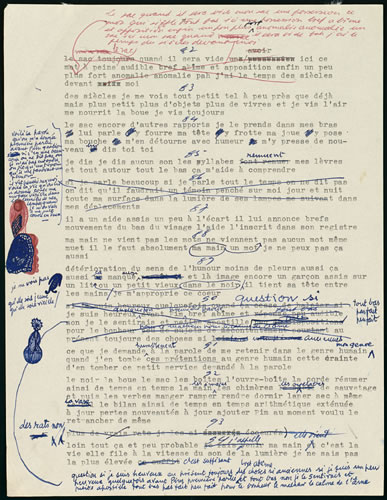
A manuscript

"How it is" written in 1961

01 May 2006

Isn't there anyone on the air?

Beckett at 100

«Today is the day we have been waiting for, even though it is better not to wait, because always what you get is less than what you hoped. 100 years since Samuel Beckett's birth. (Yes yes, they shall all now scream, "Birth was the death of him.")
"I once knew a madman who thought the end of the world had come. He was a painter--and engraver. I had a great fondness for him. I used to go and see him, in the asylum. I'd take him by the hand and drag him to the window. Look! There! All that rising corn! And there! Look! The sails of the herring fleet! All that loveliness!

(Pause.)

He'd snatch away his hand and go back into his corner. Appalled. All he had seen was ashes.
" (Endgame)
The thing is, Beckett makes me laugh. That's why I've stuck with him. Yes, there's bleakness and dreariness and the-world-is-awful and all that, but before there is that there is laughter. A sad laughter, yes, but that just makes it more meaningful and complex.

Before the laughter, there is language. That's what caused my first crush. It was "Happy Days", and yes they were -- high school, my head blown off. It took me forever to read the play. People were allowed to write like this? ("Embedded up to her waist in exact center of mound, WINNIE.") I couldn't make head or tail or kneecap of it. I wanted to know more. Who gave insane people pens to write with? Who published them? From the library, I took a copy of Waiting for Godot. I don't remember making much of it, but I do remember reading it entranced. Something in the rhythms.
"ESTRAGON:
Let's hang ourselves immediately!
VLADIMIR:
From a bough?
(They go towards the tree.)
I wouldn't trust it.
ESTRAGON:
We can always try.
VLADIMIR:
Go ahead.
ESTRAGON:
After you.
VLADIMIR:
No no, you first.
ESTRAGON:
Why me?
VLADIMIR:
You're lighter than I am.
ESTRAGON:
Just so!
VLADIMIR:
I don't understand.
ESTRAGON:
Use your intelligence, can't you?
(Vladimir uses his intelligence.)
VLADIMIR:
(finally).
I remain in the dark.
"
I couldn't stop. I read all the plays. They fit in one book and feel like a shelf. I haven't stopped reading. Now I have a case.

Eventually, I discovered the prose. Where? How? I don't remember. It took me a while. I still haven't finished Watt, fun as it is. With the prose, I tend to like it shorter -- the sublime How It Is and Texts for Nothing are particular favorites.
"Intent on these horizons I do not feel myfatiguee it is manifest none the less passage more laborious from one side to the other one semi-side prolongation of intermediate procumbency multiplication of mute imprecations

sudden quasi-certitude that another inch and I fall headlong into a ravine or dash myself against a wall though nothing I know only too well to be hoped for in that quarter this tears me from my reverie I've arrived
"
(How It Is)
Closest to my heart, though, is Endgame, perhaps because I once directed it (with high school students! Yes, I'm insane! But it turned out well, despite the odds.) and so I have lived with that text most closely. I find myself using phrases from it suddenly in everyday moments ("We'd need a proper wheel-chair. With big wheels. Bicycle wheels!"). It's an interesting enough play to read, but it's when you're in the midst of a production of it that the wonder of Beckett becomes most apparent, because the words become, somehow, living things -- not so much fragments shored against the ruins, but the magnificence of the ruins themselves, the words adorning the death of everything, an apotheosis in words, the last things left, the only things we can still apprehend after the speaker or writer is gone.
"I open the door of the cell and go. I am so bowed I only see my feet, if I open my eyes, and between my legs a little trail of black dust. I say to myself that the earth is extinguished, though I never saw it lit."
(Endgame)Ă‚»

Published in The Mumpsimus - 13 April 2006

28 April 2006

Memories are killing

«So you must not think of certain things, of those that are dear to you, or rather you must think of them, for if you don't there is the danger of finding them, in your mind, little by little. That is to say, you must think of them for a while, a good while, everyday several times a day, until they sink forever in the mud. That's an order.»
in "The Expelled" (1954)

27 April 2006

A blank target

«KEN JORDAN: How did you first hear of Waiting for Godot?
BARNEY ROSSET: Sylvia Beach, who was Joyce's publisher in Paris and the owner of the Shakespeare and Co. bookstore, called me. She knew about Grove, one way or another, and she thought maybe we would like to publish Godot. I admired her very much; I was really struck by her effort, and she bolstered my involvement with the play a great deal. Beckett had already been turned down by Simon & Schuster. All of the established publishers would have had a much better chance of doing Beckett than Grove, right? They could have paid five times as much, but nobody wanted it. Nobody was interested.The same was true of Ionesco. The Bald Soprano was put on in Paris and got a lot of attention. Don Allen, who was important editor at Grove in the beginning, liked Ionesco very early. Beckett and Ionesco were on the scene together. They liked each other. I never heard one say anything bad about the other. At a much later date, I think Ionesco became jealous because he never achieved the same level of acclaim as Beckett … and he became a nasty son of a bitch, very reactionary as he got older. But they did admire each other. You have to remember that they both wrote in French, though neither one had French as his native language. Both were not young men when they started to get recognition. Both were struggling to make it in the theatre, blasting away at the existing structure.
KJ: Do you remember when you met Beckett?
BR: I remember the exact moment. It was in the bar of the Pont Royal Hotel, which is next door to Gallimard. And at that time Sartre hung out there, as did Camus, and so on. I was with Loly, my wife at the time, and we were to meet Beckett at six for a drink. This very handsome walked in wearing a raincoat and said, "Hi, nice to meet you. I've only got forty minutes." He was all set to get rid of us! At four that morning he was buying us champagne.
KJ: So you hit it off well.
BR: Right away. He was so gentle and charming. Kind.
KJ: Beckett was extremely loyal to Grove Press, and you became close friends. How did Beckett feel about the other books that Grove published - writers like the Beats, Henry Miller?
BR: I took him to lunch with Henry Miller after we won the Tropic of Cancer verdict in Chicago. They had known each other from the thirties; they did not like each other. Everything that you read about these two would tell you that they were not easy people to get along with. But when I brought them together, each of them told me afterwards, "Boy, has he changed! He's so nice now." I don't know what Beckett thought about Miller's writing. In one of his early letters he asked if I had read J. D. Salinger's Catcher in the Rye. He said he really liked it. William Burroughs was a writer he particularly didn't understand. There is a famous anecdote about a meeting between Burroughs and Beckett, which took place in Maurice Girodias's restaurant. I remember sitting next to Sam, while Burroughs, who worshipped Beckett, was explaining to him how you do cut-ups. Beckett said to Bill, "That's not writing, that's plumbing." Allen Ginsberg and Burroughs were very unusual in the sense that they understood that Beckett was very important at that time. They wanted him, almost desperately, to recognize them, and he just didn't seem to connect. It wasn't dislike, it was just … non-togetherness. He just didn't get it. If he had read anything of Burroughs before he started doing the cut-ups maybe he'd have gotten it But the Beats didn't impinge upon his consciousness. Trocchi did. Anything of Alex Trocchi's.
KJ: When you published Godot you couldn't have thought of it as a potentially popular title.
BR: We only printed something like a thousand copies, and the first year it sold about four hundred. It wasn't until the play was produced on Broadway a couple of years later - with Bert Lahr playing Estragon - that the book started to sell, though the production only lasted six weeks in New York. The audience walked out and Walter Winchell denounced it as the new Communist propaganda. But that production made it famous.
KJ: How many copies of Godot did Grove end up selling?
BR: Well over two million.»
From an interview with Barney Rosset, founder of Grove Press, by Ken Jordan in the Winter 1997-1998 issue of The Paris Review.

26 April 2006

A Television Play

Eh Joe (1969)

«Joe, late fifties, grey hair, old dressing-gown, carpet slippers, in his room.
1. Joe seen from behind sitting on edge of bed, intent pose, getting up, going to window, opening window, looking out, closing window, drawing curtain, standing intent.
2. Joe do. (from behind) going from window to door, opening door, looking out, closing door, locking door, drawing hanging before door, standing intent.
3. Joe do. Going from door to cupboard, opening cupboard, looking in, closing cupboard, locking cupboard, drawing hanging before cupboard, standing intent.
4. Joe do. Going from cupboard to bed, kneeling down, looking under bed, getting up, sitting down on edge of bed as when discovered, beginning to relax.
5. Joe seen from front sitting on edge of bed, relaxed, eyes closed. Hold, then dolly slowly in to closeup of face. First word of text stops this movement.

CAMERA:
Joe's opening movements followed by camera at constant remove, Joe full length in frame throughout. No need to record room as whole. After this opening pursuit, between first and final closeup of face, camera has nine slight moves in towards face, say four inches each time. Each move is stopped by voice resuming, never camera move and-voice together. This would give position of camera when dolly stopped by first word of text as one yard from maximum closeup of face, Camera does not move between paragraphs till clear that pause (say three seconds) longer than between phrases. Then four inches in say four seconds when movement stopped by voice resuming.

VOICE:
Low, distinct, remote, little colour, absolutely steady rhythm, slightly slower than normal. Between phrases a beat of one second at least. Between paragraphs about seven, i.e., three before camera starts to advance and four for advance before it is stopped by voice resuming.

FACE:
Practically motionless throughout, eyes unblinking during paragraphs, impassive except in so far as it reflects mounting tension of listening. Brief zones of relaxation between paragraphs when perhaps voice has relented for the evening and intentness may relax variously till restored by voice resuming.

...
WOMAN'S VOICE:
Joe ...
(Eyes open, resumption of intentness.)
Joe ...
(Full intentness.)
Thought of everything? ... Forgotten nothing? ... You're all right now, eh? ... No one can see you now ... No one can get at you now ... Why don't you put out that light? ... There might be a louse watching you ...Why don't you go to bed? ... What's wrong with that bed, Joe? ... You changed it, didn't you? ... Made no difference? ... Or is the heart already? ... Crumbles when you lie down in the dark ... Dry rotten at last ... Eh Joe?

[CAMERA MOVE 1]

The best's to come, you said, that last time . . . Hurrying me into my coat ... Last I was favoured with from you ... Say it you now, Joe, no one'll hear you ... Come on, Joe, no one can say it like you, say it again now and listen to yourself ... The best's to come ... You were right for once ... In the end.»

A+B=C

Do we suck? Do we rule? Tell us.

Lessnessless

«Lessness is a prose piece by Samuel Beckett in which he used random permutation to order sentences. Like interactive artworks, the piece is experienced as a process that depends upon the participant’s attempts to comprehend and create meaning. Although Lessness is linear prose, its orderly disorder sets up a non-linear reading process in which contradictory perspectives are viewed simultaneously. The piece comprises two of the approximately 8.3 x 1081 possible orderings of Beckett’s 60 sentences. The authors have developed a web site that generates versions of Lessness, exploring the effects of the capabilities of computing in the creation and exploration of art.»
from "Lessness: Randomness, Consciousness and Meaning" a paper written by Mads Haahr and Elizabeth Drew.

Damn it

«I am out on leave. Thrown out on leave.
Back to time, they said, for 24 hours.
Oh my God, I said, not that.
Slip into on this shroud, they said, lest you catch your death
of cold again.
Certainly not, I said.
This cap, they said, for your deaths head skull.
Definitely not, I said.
The New World outlet, they said, in the state of Ohio.
We cannot be more precise. Pause.
Proceed straight to Lima the nearest campus, they said,
and address them.
Address whom? I said.
The students, they said, and professors.
Oh my God, I said, not that.
Do not overstay your leave, they said,
if you do not wish it to be extended.
Pause.
What am I to say? I said.
Be yourself, they said, you're yourself.
Myself? I said. What are you insinuating?
Yourself before, they said.
Pause.
And after.
Pause.
Not during? I said.»
Early monologue of "Ohio Impromptu", a dramatic fragment that was later abandoned.

25 April 2006

Synopsis

Ohio Impromptu

Two identical black clad characters with long grey hair (a Reader and a Listener) sit at a table. The Reader reads from a small book (described as "a sad tale"), and the listener, never speaking, prompts him to stop, start and repeat with knocking on the table. The play ends when the Reader finds that there is "no more to tell" from the book.

Ohio Impromptu is a short play by Samuel Beckectt. Written in English in 1980, it began as a favour to Stan Gontarski, who requested a dramatic piece to be performed at an academic symposium in Columbus, Ohio in honour of Beckett’s seventy-fifth birthday. Beckett hesitantly agreed and began work on the play at the end of March and the first week of April, 1980.

Wizard of us

An evening with endless power to irritate
Dominic Cavendish reviews Endgame at Barbican
«An accusation often levelled at Samuel Beckett is that he was too controlling. His stage directions are profuse and precise - glaring deviations from them were frowned on in his lifetime and, since his death, have sometimes met with a punitive response from his estate. But you come away from Charles Sturridge's grimly underwhelming revival of Endgame wondering whether Beckett wasn't exacting enough. Perhaps he should also have stipulated the optimum height for his actors.

I say this because Sturridge has cast a very short American actor, Peter Dinklage - with whom he worked on his recent film remake of Lassie - as Clov, the servant and sidekick of the blind, sedentary Hamm. The politically incorrect term would be "midget" - but, given that Sturridge exploits Dinklage's diminutive stature in order to enhance the play's tragi-comic effect, there is no reason to refrain from using it here.

While it is nice that showbiz-orientated dwarfs have more to look forward to these days than being fired out of cannons, the sad truth is that Dinklage isn't cut out for such a big role.

The comic gains are slight. Now the reason why Clov must amble back and forth with a ladder to survey the apocalyptic landscape outside the pair's joyless cell is not because the windows are too high up, but because he's too low down. Tee-hee.

Whenever he is mute, the actor does carry added pathos about his person, but Dinklage's approach to Beckett's badinage is so stilted that not only does all sense of familiarity between him and his cantankerous master evaporate, but also the lyricism of the writing dwindles before our ears.

Marooned on the other side of the double act, Kenneth Cranham's chair-bound, tramp-like Hamm doesn't distinguish himself much either, stuck in the rut of a rasping monotone. Two unmoving supporting performances from Tom Hickey and Georgina Hale as the spectral, dustbin-bound Nagg and Nell - the original "white trash", if you will - add to the evening's power to irritate.

Eileen Diss's deliberately flimsy-looking set stresses the theatrical in-jokery of the script, but the usual laughs prompted by lines such as "Will this never finish?" die in the throat here. The pain and despair of the quartet's terminal situation never bites, only the interminable ennui. Coming so soon after Michael Gambon and Lee Evans's stupendous account in the West End, this is a life-sapping disappointment.»
Published in the Telegraph - 24 Apr 2006

24 April 2006

Beware the sky

«One night as he sat at his table head on hands he saw himself rise and go. One night or day. For when his own light went out he was not left in the dark. Light of a kind came from the one high window. Under it still the stool on which till he could or would no more he used to mount to see the sky. Why he did not crane out to see what lay beneath was perhaps because the window was not made to open or because he could or would not open it. Perhaps he knew only too well what lay beneath and did not wish to see it again. So he would simply stand there high above the earth and see through the clouded pane the cloudless sky. Its faint unchanging light unlike any light he could remember from the days and nights when day followed hard on night and night on day. This outer light then when his own went out became his only light till it in its turn went out and left him in the dark. Till it in its turn went out.»
in "Stirrings Still" (1988)

21 April 2006

Featuring across


Beckett Centenary Festival 2006 • Gate Theatre - BarbicanbiteDublin / London

Killed by inches down by fire

«Here all is clear. No, all is not clear. But the discourse must go on. So one invents obscurities. Rhetoric. These lights, for instance (which I do not require to mean anything): what is there so strange about them, so wrong? Is it their irregularity, their instability, their shining strong one minute and weak the next, but never beyond the power of one or two candles? Malone appears and disappears with the punctuality of clockwork, always at the same remove, the same velocity, in the same direction, the same attitude. But the play of the lights is truly unpredictable. It is only fair to say that to eyes less knowing than mine they would probably pass unseen. But even to mine do they not sometimes do so? They are perhaps unwavering and fixed, and my fitful perceiving the cause of their inconstancy.»
in "The Unnamable" (1958)

20 April 2006

Da Tagte Es

«redeem the surrogate goodbyes
the sheet astream in your hand
who have no more for the land
and the glass unmisted above your eyes»
in "Echo's Bones" (1935)

Can't get there from here

«WORSTWARD HO, by Samuel Beckett (Grove; $8.95). These forty-one small pages of very large type extend Beckett's wrestle with the void to the point where less would be nothing. A personless voice, uttering words of mostly one syllable in sentences of rarely more than five words, urges itself onward in a dim but resistant realm where humanoid apparitions fragmentarily loom and then fade. "So leastward on. So long as dim still. Dim undimmed. Or dimmed to dimmer still. To dimmost dim. Leastmost in dimmost dim. Unworsenable worst." The dim shapes in this environment most minimal are called shades, and we probably would not be entirely wrong to think of it as an old-fashioned Hades that ends in new-style entropy. ("Vast apart. At bounds of boundless void. Whence no farther.") A sterile, dreadful exercise, it might be said, and one does not, as Dr. Johnson remarked of "Paradise Lost", wish it's longer than it is. And yet, the words—"How almost true they sometimes almost ring! How wanting in inanity!"
Review in The New Yorker, March 1984

19 April 2006

Shoulder blades

«"Damned to Fame" is not the first life of Beckett, of course. Notably, there was Deirdre Bair's 1978 biography, which drew on many letters she had discovered from Beckett to his friend Tom MacGreevy. They dispel the notion of Beckett as a philosophical recluse and show him as a man whose troubles shaped his writing. Mr. Knowlson has had full access to the MacGreevy letters, unlike Ms. Bair, and to six notebooks reporting Beckett's mind-altering trip through Germany in 1936-37. He added dozens of other sources. Beckett died six months after Mr. Knowlson began his work (he retired as a professor of French at the University of Reading in England to take it on). For five months, in brief visits, they discussed his life. Mr. Knowlson's presentation of these materials is academically invaluable. Much more important, he has composed a remarkable portrait of an impressive man. "Damned to Fame" is a magnificent biography.

Beckett's writings hold their audience because they are emotionally intense and disturbing. They are also richly allusive, evocative of literature, art, music, philosophy and psychology. Mr. Knowlson speaks authoritatively about these matters, without ostentation. He gives credit unstintingly; he even mentions me once.

The biography, though sadly shortened from the manuscript, is enlivened by suggestive details. Examples: Beckett's maternal grandmother rebuked a granddaughter who loved chocolates. "You shouldn't love something to eat, my dear. You should only love God." His uncle Gerald Beckett, rather different, called life "a disease of matter." When Beckett's father died, Gerald comforted the widow: "Well, May, he's got it over. What is it all about, in the end, for us all, from the cry go, but get it over?"

Such anecdotes bring alive decades of Beckett's public accomplishments and private doubts, regrets and illness. Mr. Knowlson modestly claims to have found new materials in three areas: "music and art", Beckett's political activities and Beckett's character. Readers will find much more.

Beckett's lifelong absorption in classical music (he was a competent pianist) and his concern for the verbal music of his own writings are matched by his knowledge of art: "He could spend as much as an hour in front of a single painting (...) savoring its forms and its colors, reading it, absorbing its minutest detail." Mr. Knowlson also shows how Beckett's dramatic scenes, figures, gestures and lighting echo these artworks.

The German diaries record Beckett's many meetings with painters, and discussions of paintings. They also convey his distaste for Germany's increasing anti-Semitism and censorship and Hitler's long, shrill speeches.

That topic prepares us for Beckett's activities with a French Resistance group and with the Irish Red Cross in France after World War II. In this grim work he displayed "astonishing powers of concentration, a meticulous attention to detail", Mr. Knowlson says; he could "organize, reduce and sift very diffuse material so as to make it succinct and intelligible." Those qualities recur in his writings. Additionally, "sheer obstinacy (...) was, he commented himself, a constant trait in his character."

That difficult, variable character is Mr. Knowlson's major theme. He describes a model of upper-class Protestant gentility: the 4-year-old praying; the youth playing golf, tennis, rugby and cricket, swimming, boxing, running track and racing motorcycles; and the college student who neither smoked nor drank.

But higher education puts at risk conventional faiths and values: "On the key issue of pain, suffering and death (...) Beckett's religious faith faltered and quickly foundered." A sermon in which a Canon Dobbs said that the only thing he could tell the suffering, dying and bereaved was, "The Crucifixion was only the beginning. You must contribute to the kitty", shook Beckett. So did Dobbs's advice to the unhappy: "When it's morning, wish for evening. When it's evening, wish for morning." Adding Baudelaire, Beckett sharpened that idea in "Endgame": "You cried for night; it falls: now cry in darkness."

Beckett discovered Dante and recent French writers at Trinity College, Dublin. He won an appointment to the Ecole Normale Superieure in Paris, met James Joyce and published a monograph on Proust. His career was under way. But this flawed summary evades the harshness of his writings.

Here Mr. Knowlson is especially valuable, providing persuasive detail. The young Beckett was an arrogant and withdrawn brat: "He confessed later to feelings of superiority and contempt, which led to a depression that came to seem (...) 'morbid.'" Teaching at Trinity, he met his like among colleagues. "Scholarly wit and sarcasm", Mr. Knowlson says, "sounded all too often like exhibitionism, bitchiness and character assassination." As for creativity: "How can one write here", Beckett complained, "when every day vulgarizes one's hostility and turns anger into irritation and petulance?"

Those perceptions, and psychosomatic illnesses, led to painful psychological insight. Beckett abandoned teaching and entered therapy after his father's death in 1933. Mr. Knowlson is eloquent about the effects of that death. The therapy lasted about six months, Beckett told him. (He once told me three.) "In reality his treatment lasted nearly two years", Mr. Knowlson says.

What Beckett would not tell him he had written to MacGreevy. In March 1935, after some 150 sessions, he wrote an amazing letter. With bitterness and detachment he summarized what he now knew about his illness. Mr. Knowlson specifies its causes: "the intensity of his mother's attachment to him and his powerful love-hate bond with her." Later, fleeing his mother and Ireland after a dreadful quarrel, Beckett offered MacGreevy a memorable phrase: "I am what her savage loving has made me."

Accurate analysis is not therapy. The relationship and its effects continued. Even in his last months, Mr. Knowlson says, "Beckett's feelings of love for his mother and remorse at having, as he saw it, let her down so frequently, struck me as still intense, almost volcanic." About his remarkable wife, Suzanne, who died some months earlier than he, he suffered similar guilt and remorse.

But that hard-won knowledge of his psyche had altered him. Mr. Knowlson describes his letter of self-analysis as "the first convincing explanation of how the arrogant, disturbed, narcissistic young man (...) evolved into someone who was noted later for his extraordinary kindness, courtesy, concern, generosity and almost saintly 'good works.'"

Beckett's outer world is not neglected, although space limitations restrict discussion of the trilogy of novels, "almost certainly the most enduring works that Beckett wrote." Mr. Knowlson is insightful about the plays and detailed about their performances. A playwright gives hostages to fortune. We hear of many misfortunes and some near misses, especially with "Godot." Imagine Buster Keaton as Vladimir and Marlon Brando as Estragon.

The inner world persists. Beckett remains painfully aware of his faults, unable to mend them and struggling to compensate for them, as Mr. Knowlson guides us through the powerful writings in which he dramatized the blackness in his psyche.

Beckett becomes his own finest character. Mr. Knowlson is with him to the final curtain, unblinking: "Beckett became frailer and thinner. His hands were now noticeably distorted. (...) Greeting him with a fond embrace, you noticed how prominent his shoulder blades felt (...) and how thin his wrists and forearms had become.'' Born on Good Friday, April 13, 1906, he died on Friday, Dec. 22, 1989.

What is the meaning of this complicated life? Mr. Knowlson reports discussing with Beckett his brief autobiographical novel "Company": "We laughed uproariously at the idea of reaching 'truth' in so shifty an area as a human life." Weeks before he died, William Butler Yeats wrote: "When I try to put it all into a phrase I say, 'Man can embody truth but he cannot know it.' I must embody it in the completion of my life." "Damned to Fame" splendidly preserves the truths embodied in Beckett's life.»
published in The New York Times, Aug. 3, 1997.

Upon the shores of plenitude

"Hear no more", he said. "Hear no more".
And as far as he was walking the flood of noise came to a dim of light. An empty box full of motionless. Silent waves approach him as subtle as a distant shore. And in the end. The end of all his steps. He could not manage himself to hear anything. There was a black vow of silence inside his soft machine. The ears were sealed by propelling desire. By an instant blink of his brain. And then. Only then. He could live along. Peacefully.

Afterwards he placed all the words together on the way to a poem. Words he didn't noticed before. Now they were just in front of his eyes, dripping as a flag.

The Lobule, the Scalpha, the Tragus. The Helix and the Anti-Helix. The Concha and the Anti-Tragus. And finally, mute as a dead flower, the Fossa Triangularis.

I never had a bicycle

«CLOV: Why do you keep me?
HAMM: There's no one else.
CLOV: There's nowhere else. (Pause.)
HAMM: You're leaving me all the same.
CLOV: I'm trying.
HAMM: You don't love me.
CLOV: No.
HAMM: You loved me once.
CLOV: Once!
HAMM: I've made you suffer too much. (Pause.) Haven't I?
CLOV: It's not that.
HAMM: I haven't made you suffer too much?
CLOV: Yes!»
in "End Game" a play in one act

Poor eyesight

Feldman meets Beckett
by James Knowlson

This extract is taken from 'Damned to Fame'. The Life of Samuel Beckett by James Knowlson, published in Great Britain by Bloomsbury Publishing plc, London, at £25.00 hardback and £8.99 in paperback and by Simon and Schuster in New York at $35 hardback and $20 in Touchstone paperback. The extract recounts the 1976 meeting between Feldman and Beckett in Berlin where Beckett was rehearsing his plays Footfalls and That Time. (The
numbers in brackets refer to the notes in Knowlson's book, reproduced here at the end of the text.)

«Around noon on 20 September, during a rehearsal at the Schiller-Theater, the American composer and Professor of Music at the State University of New York at Buffalo, Morton Feldman came to meet Beckett in the small Werkstatt theatre. Feldman, who wore thick horn-rimmed glasses because his eyesight was so poor, related how he met Beckett and their subsequent conversation:

I was led from daylight into a dark theatre, on stage, where I was presented to an invisible Beckett. He shook hands with my thumb and I fell softly down a huge black curtain to the ground. The boy [who had escorted him] giggled. There were murmurs. I was led down steps to a seat in the front aisles... [96]

After this unpropitious start, Feldman invited Beckett to lunch at a nearby restaurant, where Beckett only drank a beer.

He [Beckett] was very embarassed - he said to me, after a while: 'Mr. Feldman, I don't like opera.' I said to him, 'I don't blame you!' Then he said to me 'I don't like my words being set to music,' and I said, 'I'm in complete agreement. In fact it's very seldom that I've used words. I've written a lot of pieces with voice, and they're wordless.' Then he looked at me again and said, 'But what do you want?' And I said 'I have no idea!' He also asked me why I didn't use existing material ... I said that I had read them all, that they were pregnable, they didn't need music. I said that I was looking for the quintessence, something that just hovered. [97]

Feldman then showed Beckett the score of some music that he had written on some lines from Beckett's script for Film. Showing keen interest in the score, Beckett said that there was only one theme in his life. Then he spelled out this theme.

'May I write it down?' [asked Feldman]. (Beckett himself takes Feldman's music paper and writes down the theme ... It reads 'To and fro in shadow, from outer shadow to inner shadow. To and fro, between unattainable self and unattainable non-self.') ... 'It would need a bit of work, wouldn't it? Well, if I get any further ideas on it, I'll send them on to you.' [98]

At the end of the month, still in Berlin, Beckett mailed to Morton Feldman in Buffalo a card with a note 'Dear Morton Feldman. Verso the piece I promised. It was good meeting you. Best. Samuel Beckett.' [99] On the back of the card was the handwritten text (Beckett never called it a poem) entitled 'Neither', beginning 'to and fro in shadow/ from inner to outer shadow/ from impenetrable self to impenetrable unself/ by way of neither'. The text compares the self and the unself to 'two lit refuges whose doors once neared gently close' and owes one striking image to the play on which he was working so intently: 'unheard footfalls only sound'.

Beckett did not know Feldman's work at all when he wrote the text for him. But, by a strange coincidence, only a few days after posting 'Neither', and in London by this time, he was listening to Patrick Magee reading his own For To End Yet Again on BBC Radio 3, when he noticed that, in the second part of the 'Musica Nova' concert that followed the reading, there was an orchestral piece by Morton Feldman. He listened to it and found he liked it very much. [100]»

Notes:
96. John Dwyer, 'In the Shadows with Feldman and Beckett', Lively Arts, Buffalo News, 27 Nov. 1976.
97. Howard Skempton, interview with Morton Feldman in Music and Musicians, May 1977, p. 5.
98. John Dwyer, 'In the Shadows with Feldman and Beckett', 27 Nov. 1976.
99. Samuel Beckett to Morton Feldman, 31 Sept. [must be an error for 1 Oct.] 1976 sent by Feldman with an explanatory letter to James Knowlson, 6 Sept. 1977. MS 3033 (Archive of the Beckett International Foundation, University of Reading).
100. Samuel Beckett to John Beckett, 18 Oct. 1976 (John Beckett). The Feldman work Beckett listened to was Orchestra (1976). This had been commissioned by the Glasgow new music festival Musica Nova 1976 and was first performed on 18th Sept. by the Scottish National Orchestra conducted by Elgar Howarth. BBC Radio 3 broadcast a recording of this first performance on 4th Oct. immediately following the reading of Beckett's text (BBC Radio Times, 4th Oct. 1976).

18 April 2006

First the body


Made by Litten Design with excerpts from "Worstward Ho"

Lehen Ekitaldia

«VLADIMIR (mindurik, hozki): Jakin ote daiteke non igaro duen berorrek gaua?
ESTRAGON: Hobi batean.
VLADIMIR (txunditurik): Hobi batean! Non hola?
ESTRAGON (keinurik gabe): Hor barrena.
VLADIMIR: Eta ez haute egurtu?
ESTRAGON: Bai... Ez gehiegi ere.
VLADIMIR: Lehengo berak al ziren?
ESTRAGON: Lehengoak? Ez zakiat.»
in "Godoten esperoan" - Basque version of "Waiting for Godot"

[TRANSLATION]
«VLADIMIR (hurt, coldly): May one inquire where His Highness spent the night?
ESTRAGON: In a ditch.
VLADIMIR (admiringly): A ditch! Where?
ESTRAGON (without gesture): Over there.
VLADIMIR: And they didn't beat you?
ESTRAGON: Beat me? Certainly they beat me.
VLADIMIR: The same lot as usual?
ESTRAGON: The same? I don't know.»

Wild inside the grass

«He was found lying on the ground. No one had missed him. No one was looking for him. An old woman found him. To put it vaguely. It happened so long ago. She was straying in search of wild flowers. Yellow only. With no eyes but for these she stumbled on him lying there. He lay face downward and arms outspread. He wore a greatcoat in spite of the time of year. Hidden by the body a long row of buttons fastened it all the way down. Buttons of all shapes and sizes. Worn upright the skirts swept the ground. That seems to hang together. Near the head a hat lay askew on the ground. At once on its brim and crown. He lay inconspicuous in the greenish coat. To catch an eye searching from afar there was only the white head. May she have seen him somewhere before? Somewhere on his feet before? Not too fast. She was all in black. The hem of her long black skirt trailed in the grass. It was close of day. Should she now move away into the east her shadow would go before. A long black shadow. It was lambing time. But there were no lambs. She could see none. Were a third party to chance that way theirs were the only bodies he would see. First that of the old woman standing. Then on drawing near it lying on the ground. That seems to hang together. The deserted fields. The old woman all in black stockstill. The body stockstill on the ground. Yellow at the end of the black arm. The white hair in the grass. The east foundering in night. Not too fast. The weather. Sky overcast all day till evening. In the west-north-west near the verge already the sun came out at last. Rain? A few drops if you will. A few drops in the morning if you will. In the present to conclude. It happened so long ago. Cooped indoors all day she comes out with the sun. She makes haste to gain the fields. Surprised to have seen no one on the way she strays feverishly in search of the wild flowers. Feverishly seeing the imminence of night. She remarks with surprise the absence of lambs in great numbers here at this time of year. She is wearing the black she took on when widowed young. It is to reflower the grave she strays in search of the flowers he had loved. But for the need of yellow at the end of the black arm there would be none. There are therefore only as few as possible. This is for her the third surprise since she came out. For they grow in plenty here at this time of year. Her old friend her shadow irks her. So much so that she turns to face the sun. Any flower wide of her course she reaches sidelong. She craves for sundown to end and to stray freely again in the long afterglow. Further to her distress the familiar rustle of her long black skirt in the grass. She moves with half-closed eyes as if drawn on into the glare. She may say to herself it is too much strangeness for a single March or April evening. No one abroad. Not a single lamb. Scarcely a flower. Shadow and rustle irksome. And to crown all the shock of her foot against a body. Chance. No one had missed him. No one was looking for him. Black and green of the garments touching now. Near the white head the yellow of the few plucked flowers. The old sunlit face. Tableau vivant if you will. In its way. All is silent from now on. For as long as she cannot move. The sun disappears at last and with it all shadow. All shadow here. Slow fade of afterglow. Night without moon or stars. All that seems to hang together. But no more about it.»
in "One Evening"

What would I do without this world

«what would I do without this world faceless incurious
where to be lasts but an instant where every instant
spills in the void the ignorance of having been
without this wave where in the end
body and shadow together are engulfed
what would I do without this silence where the murmurs die
the pantings the frenzies towards succour towards love
without this sky that soars
above its ballast dust

what would I do what I did yesterday and the day before
peering out of my deadlight looking for another
wandering like me eddying far from all the living
in a convulsive space
among the voices voiceless
that throng my hiddenness»
Translated by Beckett himself (Samuel Beckett, Collected poems... Ibid.)

Last living soul

Samuel Beckett, Birthday Boy
For the great writer's centennial, a lot of high-grade hoopla and an edition of his work that finally does him justice.

By David Gates / Newsweek / April 13, 2006
«One of Samuel Beckett's favorite things about himself—and this depression-prone man probably didn't have many—was that he'd been born on a Good Friday that was also Friday the 13th. That was in 1906, and Thursday is his centennial. (He died in 1989.)

His very name was a byword for bleakness. Of course most people who've actually read Beckett also find his work deeply emotional and wildly funny—but that's never added up to a lot of people, if you leave aside those who got assigned "Waiting for Godot" in high school. Beckett was a marginal, expatriate Irish writer who'd given up on English and wrote in French, and that play transformed him virtually overnight into a celebrity, from a no-hoper struggling with what may have seemed to him a long, unpublishable manuscript. This was his trilogy of novels—"Molloy," "Malone Dies" and "The Unnamable"—his greatest achievement. (He wrote "Godot" to give himself some R&R before "The Unnamable," the 20th century's most relentless novel.) Beckett called this period, from 1946 to 1950, "the siege in the room." It's a wonder that this black hole of energy didn't cause power blackouts all over Paris.

As you'd expect, his centennial is the occasion for festschrifts, festivals ("Beckett festival" no longer sounds oxymoronic) and reminscences from friends and acquaintances who hadn't already weighed in, and from some who had. New productions of the plays. Scholarly conferences. Why run it all down when you're going to skip it anyway? If you care, Google "Beckett centennial" and I'm sure some of the 171,000 hits will fill you in.

But one tribute is indispensable: Grove Press's hardbound, four-volume set of Beckett's work—novels, plays, poems and essays—with an additional volume devoted to a bilingual "Godot" (the original French and Beckett's own English translation). The editor, novelist Paul Auster, left out a couple of long pieces Beckett chose not to publish during his lifetime—when he could have published his grocery lists if he'd wanted. You can argue this decision convincingly either way, but I'm with Auster: keep it canonical. Anyhow, the novel, "A Dream of Fair to Middling Women," and the play "Eleutheria" were still in print the last time I looked. Auster had the sense to put "First Love" with the three similar and contemporaneous short stories which had always been published separately. And he's assigned introductory essays to Salman Rushdie, Edward Albee, Colm Toibin and J. M. Coetzee. They may be useful (some more than others), but I think this was a bad call: such an enterprise should be a monument, not an opportunity for other writers' self-display, however reverent. Still, you're perfectly free to skip them. (If you're going to read Rushdie's piece, by the way, start a few pages in, when he's done talking about himself.)

Perhaps the best thing Auster did was to let a decent copy editor—if he didn't spit on his hands and do it himself—clean up the annoying and depressing misprints that have persisted through edition after edition of the trilogy. It shouldn't have taken Beckett's publisher all these years to start taking proper care of him. I'm hardcore when it comes to Beckett, and I was disappointed to see that a punctuation decision in "Molloy" that's always bothered me remains as it was; but there may simply not have been enough justification (in the manuscript, say) for making what seems like a logical change. On the other hand, I still prefer the old hypermodern covers Grove used for the '60s paperbacks—those stark, almost violent, typefaces and broken abstract images. The new books look more conventional, less scary, with silhouettes of "Godot"'s leafless tree, the wheel of Molloy's bicycle and, thankfully, a variant of the broken circle on the old cover of "Watt." Still, the black spines and endpapers help give the impression that you're entering a dark and special country.

If you haven't read many—or any—of the pieces in these handsome, sober volumes, I can't take you by the collar and march you into a bookstore. It's 24 bucks a volume, and $22 for the bilingual "Godot," which, if your French is as shot as mine, is just going to sit there. You could buy a fancy meal with a good bottle of wine for that kind of money. So, up to you. Auster calls reading Beckett "an experience unequaled anywhere in the universe of words." I say, Beckett's the man. Don't you want to check it out, if only so you can write in and say we're both crazy?»

Juicebag

«No trace anywhere of life, you say, pah, no difficulty there, imagination not dead yet, yes, dead, good, imagination dead imagine. Islands, waters, azure, verdure, one glimpse and vanished, endlessly, omit. Till all white in the whiteness the rotunda. No way in, go in, measure. Diameter three feet, three feet from ground to summit of the vault. Two diameters at right angles AB CD divide the white ground into two semicircles ACB BDA. Lying on the ground two white bodies, each in its semicircle. White too the vault and the round wall eighteen inches high from which it springs. Go back out, a plain rotunda, all white in the whiteness, go back in, rap, solid throughout, a ring as in the imagination the ring of bone. The light that makes all so white no visible source, all shines with the same white shine, ground, wall, vault, bodies, no shadow. Strong heat, surfaces hot but not burning to the touch, bodies sweating. Go back out, move back, the little fabric vanishes, ascend, it vanishes, all white in the whiteness, descend, go back in. Emptiness, silence, heat, whiteness, wait, the light goes down, all grows dark together, ground, wall, vault, bodies, say twenty seconds, all the greys, the light goes out, all vanishes. At the same time the temperature goes down, to reach its minimum, say freezing-point, at the same instant that the black is reached, which may seem strange. Wait, more or less long, light and heat come back, all grows white and hot together, ground, wall ,vault, bodies, say twenty seconds, all the greys, till the initial level is reached when the fall began. More or less long, for there may intervene, experience shows, between end of fall and beginning of rise, pauses of varying length, from the fraction of the second to what would have seemed, in other times, other places, an eternity.»
in "Imagination Dead Imagine"

17 April 2006

One for the road

Beckett is ageless!

Inhale

"BREATH"

[CURTAIN]

1. Faint light on stage littered with miscellaneous rubbish. Hold about
five seconds.
2. Faint brief cry and immediately inspiration and slow increase of light
together reaching maximum together in about ten seconds. Silence and
hold for about five seconds.
3. Expiration and slow decrease of light together reaching minimum
together (light as in 1) in about ten seconds and immediately cry as
before. Silence and hold about five seconds.

[CURTAIN]

RUBBISH
No verticals, all scattered and lying.

CRY
Instant of recorded vagitus. Important that two cries be identical,
switching on and off strictly synchronized light and breath.

BREATH
Amplified recording.

MAXIMUM LIGHT
Not bright. If 0 = dark and 10 = bright, light should move from about
3 to 6 and back.

Open your mouth

Londoners gasp at Beckett's 35-second play

By Paul Keller - LONDON, Feb 11, 99 (Reuters)
«To admirers, a play that has no actors, just a stage littered with rubbish and takes 35 seconds to perform is a sardonic comment on the brevity of life.
To others, it's a pretentious piece of nonsense.
The play in question, "Breath", is making its London West End debut. It was written by the late avant-garde Irish playwright and Nobel prize winner Samuel Beckett.
Beckett's reputation doesn't matter a jot to the play's detractors. The enigmatic quality of one of the world's shortest dramatic performances simply enrages some.
"I just want to put on record that I thought the whole evening was completely bogus and pretentious," was one spectator's view.
The rarely staged piece features in a double bill with a 45-minute Beckett play, "Krapp's Last Tape", at the Arts Theatre, a small playhouse in London's theatreland.
That the play is controversial should be no surprise. Beckett's austere, tragi-comic works are notorious for dividing critical opinion and for flouting the theatrical conventions of time, plot and character.
When "Waiting for Godot" was first staged nearly 50 years ago, critics ridiculed the story of two tramps who do nothing but hang about and bicker. It went on to achieve international fame and has been translated into
several languages. It regularly features in critics' lists of plays of the century.

35 SECONDS LONG -- WHAT ELSE WOULD WE BE DOING?

The stage directions for "Breath" occupy a single page and take longer to read than the performing of them.
A stage strewn with debris becomes visible in a light that starts as faint, becomes less faint then fades again.
Simultaneously the audience hears a faint cry, what Beckett calls an "instant of recorded vagitus", then the sound of a human breath, followed by another faint cry as the lights fade and the curtain falls. Blink and you'd miss it.
"It's all very well to read about "Breath" but I thought it'd be fascinating to see what it actually amounts to," said Edward Petherbridge, a veteran British actor responsible for bringing "Breath" to London after an international tour.
Written in 1969, the play is viewed as something of a theatrical novelty. Its appeal is usually reckoned to be restricted to die-hard Beckett aficionados and theatre directors with a taste for the bizarre.
"I thought there might be a few people in London who might like to see it. And I was right there are a few people," he quips, referring to the less than sell-out appeal Beckett's ultra-minimalist play has had for
London theatre goers.
The play is backed by the Royal Shakespeare Company (RSC), one of Britain's top theatre companies. Persuading the RSC to put it on was no pushover either, Petherbridge recalls.
"I remember when some of us started to lose our nerve about it and wondered whether it was really worth doing, I heard myself saying that it was a very good play, it only takes 35 seconds to run -- What else would
we be doing?"

BECKETT AND THE NAKED BODIES

Audience reaction to "Breath" ranges between respectful silence and uncontrollable mirth, says Petherbridge who is unrepentant about stageing the play.
"It seemed a chance to put it on. There are not that many. After all you can't imagine coming just to see it."
Petherbridge says people find "Breath" quietly affecting and, like other Beckett plays, the imagery oddly haunting.
The two-act play "Happy Days" has a woman buried up to her waist, then up to her neck, in sand; another play has two characters living in dustbins; while a lone, disembodied mouth is the focus of a disturbing monologue called "Not I".
"Breath" achieved uninvited notoriety 30 years ago when top British theatre critic Kenneth Tynan asked Beckett for a contribution to his bawdy London revue "Oh Calcutta!"
Tynan included "Breath" in the revue but with one crucial amendment -- naked bodies were added to the rubbish as the play's props. Beckett was reported to be appalled, especially as the revue's programme attributed the work to him.
"So this is the first London production of "Breath" in its purest form," says Petherbridge.
In its sparse, inexplicable form, "Breath", superficially at least, seems to sum up a writer who loathed the limelight and avoided explaining the meaning of his work.

Even when awarded the Nobel Literature Prize in 1969, Beckett stayed at home. He never gave press interviews.»

Room 604


Seated in Room 604, The Hyde Park Hotel, London, 1980 / © John Minihan

INSTRUCTIONS: Print this photo with the size of the building in front of you. Take a great portion of glue and go to the roof of the structure. Roll down the photo. With the help of some climbing ropes go down slowly and strain the paper against the windows and walls of the building. Spread the glue evenly. Come down safely.
Take a photo and send it to us.
RUN!

Included for company

«...and having heard that when a man in a forest thinks he is going in a straight line, in reality he is going in a circle, I did my best to go in a circle, hoping in this way to go in a straight line. For I stopped being half-witted and became sly, whenever I took the trouble. And my head was a storehouse of useful knowledge. And if I did not go in a rigorously straight line, with my system of going in a circle, at least I did not go in a circle, and that was something.»
in "Molloy" [1955]

Glimpse over

"WHAT IS THE WORD"
for Joe Chaikin

«folly -
folly for to -
for to -
what is the word -
folly from this -
all this -
folly from all this -
given -
folly given all this -
seeing -
folly seeing all this -
this -
what is the word -
this this -
this this here -
all this this here -
folly given all this -
seeing -
folly seeing all this this here -
for to -
what is the word -
see -
glimpse -
seem to glimpse -
need to seem to glimpse -
folly for to need to seem to glimpse -
what -
what is the word -
and where -
folly for to need to seem to glimpse what where -
where -
what is the word -
there -
over there -
away over there -
afar -
afar away over there -
afaint -
afaint afar away over there what -
what -
what is the word -
seeing all this -
all this this -
all this this here -
folly for to see what -
glimpse -
seem to glimpse -
need to seem to glimpse -
afaint afar away over there what -
folly for to need to seem to glimpse afaint afar away over there what -
what -
what is the word -

what is the word»

[This was the very last work of Samuel Beckett, was written in bed in the nursing home where he spent the last period of his life in 1989, the year of his death, and was published in 1990. The soundly silence of his words was never so well achieved like in this text. We can feel the tempest of all his life coming from our mouths when we read it aloud.]

Cause they don't know what's really real now

«In Paris, in January of 1938, while refusing the solicitations of a notorious pimp who ironically went by the name of Prudent, Beckett was stabbed in the chest and nearly killed. James Joyce arranged a private room for the injured Beckett at the hospital. The publicity surrounding the stabbing attracted the attention of Suzanne Descheveaux-Dumesnil, who knew Beckett slightly from his first stay in Paris; this time, however, the two would begin a lifelong companionship.
At a preliminary hearing, Beckett asked his attacker for the motive behind the stabbing, and Prudent casually replied, "Je ne sais pas, Monsieur. Je m'excuse" ("I do not know, sir. I'm sorry"). Beckett occasionally recounted the incident in jest, and eventually dropped the charges against his attacker—partially to avoid further formalities, but also because he found Prudent to be personally likable and well-mannered.»
from Wikipedia

Oh, the lights are blinking

«Look! A tree! Maybe we should hang ourselves?»
in "Waiting for Godot"

Beckett's Flu

«Here he stood. Here he sat. Here he knelt. Here he lay. Here he moved, to and fro, from the door to the window, from the window to the door; from the window to the door, from the door to the window; from the fire to the bed, from the bed to the fire; from the bed to the fire, from the fire to the bed; from the door to the fire, from the fire to the door; from the fire to the door, from the door to the fire; from the window to the bed, from the bed to the window; from the bed to the window, from the window to the bed; from the fire to the window, from the window to the fire; from the window to the fire, from the fire to the window; from the bed to the door, from the door to the bed; from the door to the bed, from the bed to the door; from the door to the window, from the window to the fire; from the fire to the window, from the window to the door; from the window to the door, from the door to the bed; from the bed to the door, from the door to the window; from the fire to the bed, from the bed to the window; from the window to the bed, from the bed to the fire; from the bed to the fire, from the fire to the door; from the door to the fire, from the fire to the bed; from the door to the window, from the window to the bed; from the bed to the window, from the window to the door; from the window to the door, from the door to the fire; from the fire to the door, from the door to the window; from the fire to the bed, from the bed to the door; from the door to the bed, from the bed to the fire; from the bed to the fire, from the fire to the window; from the window to the fire, from the fire to the bed; from the door to the fire, from the fire to the window; from the window to the fire, from the fire to the door; from the window to the bed, from the bed to the door; from the door to the bed, from the bed to the window; from the fire to the window, from the window to the bed; from the bed to the window, from the window to the fire; from the bed to the door, from the door to the fire; from the fire to the door, from the door to the bed...»
in "Watt" [Olympia Press, 1953]

Instructions

Grab a Beckett's text (grab a Beckett's picture), mark it down, print it the size you want (or just print it as a reference). Or write it in a piece of paper or into a notebook. Take it outside, take it to the street. Find a nice spot. Any place, anywhere. Copy it to the wall, to the garment, to the ceiling (the sky). By hand, by stick it out, by pressure.
Run if needed.
Afterwards take a photo (make a movie!) and send it to us. We will publish it here.

SPREAD THE WORD!

Always returning

«All known all white bare white body fixed one yard legs joined like sewn. Light heat white floor one square yard never seen. White walls one yard by two white ceiling one square yard never seen. Bare white body fixed only the eyes only just. Traces blurs light grey almost white on white. Hands hanging palms front white feet heels together right angle. Light heat white planes shining white bare white body fixed ping fixed elsewhere. Traces blurs signs no meaning light grey almost white. Bare white body fixed white on white invisible. Only the eyes only just light blue almost white. Head naught eyes light blue almost white silence within. Brief murmurs only just almost never all known. Traces blur signs no meaning light grey almost white. Legs joined like sewn heels together right angle. Traces alone uncover given black light grey almost white on white. Light heat white walls shining white one yard by two. Bare white body fixed one yard ping fixed elsewhere. Traces blurs signs no meaning light grey almost white...»
in "Ping"

16 April 2006

My calculations of the world

«One day suddenly it dawned on me, dimly, that I might perhaps achieve my purpose without increasing the number of my pockets, or reducing the number of my stones, but simply by sacrificing the principle of trim.
The meaning of this illumination, which suddenly began to sing within me, like a verse of Isaiah, or of Jeremiah, I did not penetrate at once, and notably the word trim, which I had never met with, in this sense, long remained obscure. Finally I seemed to grasp that this word trim could not here mean anything else, anything better, than the distribution of the sixteen stones in four groups of four, one group in each pocket, and that it was my refusal to consider any distribution other than this that had vitiated my calculations until then and rendered the problem literally insoluble. And it was on the basis of this interpretation, whether right or wrong, that I finally reached a solution, inelegant assuredly, but sound, sound. Now I am willing to believe, indeed I firmly believe, that other solutions to this problem might have been found and indeed may still be found, no less sound, but much more elegant than the one I shall now describe, if I can...»
in "Molloy" [1955]

15 April 2006

This is how it will be!

«I shall not be alone, in the beginning. (I am of course alone.) Alone. That is soon said. (Things have to be soon said.) And how can one be sure, in such darkness? I shall have company. In the beginning. A few puppets. Then I'll scatter them, to the winds, if I can.»
in "The Unnamable"