22 May 2006

Boston Globe

Theater in bloom
''Happy Days": Gloucester Stage Company marks Samuel Beckett's 100th birthday -- and artistic director Israel Horovitz's final season -- with a true gift to audiences: Scott Edmiston directing Nancy E. Carroll as Winnie, the quintessential Beckett character, bleakly hopeful and buried up to her neck. In a season that also features tributes to Horovitz from such luminaries as Jill Clayburgh and Peter Boyle, this is a standout. Gloucester Stage Company, Gloucester, July 6-16. 978-281-4433, http://www.gloucesterstage.com/.

''Hamlet": Artistic director Tina Packer keeps it all in the family for what is, amazingly, Shakespeare & Company's first production ever of this jewel in Shakespeare's crown. Packer plays Gertrude to her real-life son Jason Asprey's Hamlet, while her husband, Dennis Krausnick, plays Polonius. No doubt they're wise to have a nonrelative, Eleanor Holdridge, direct. Shakespeare & Company, Lenox, July 1-August 27. 413-637-1199, http://www.shakespeare.org/.

''Johnny Got His Gun": Among the offerings in a diverse and adventurous season at Wellfleet Harbor Actors Theater is one that seems particularly pointed in the current political climate: a stage version of Dalton Trumbo's antiwar classic ''Johnny Got His Gun." If it's anywhere near as powerful as Trumbo's 1939 novel, this adaptation by Bradley Rand Smith (directed by Neal Huff) promises to enrage, enlighten, and provoke. Wellfleet Harbor Actors Theater, Wellfleet, June 25-July 11. 508-349-9428, 866-282-9428, http://www.what.org/.

''Copenhagen": Michael Frayn's Tony Award-winning speculation on a mysterious conversation between German physicist Werner Heisenberg and his Danish mentor, Niels Bohr, takes the uncertainty principle far beyond physics. It also takes the Publick Theatre further along on its mission to expand its ''theater of the spoken word" beyond the Shakespeare productions that were, until last season's hit ''Arcadia," the outdoor stage's stock in trade. Publick Theatre, Brighton, July 20-Sept. 10. 617-782-5425, http://www.publicktheatre.com/.

''Double Double": The Williamstown Theatre Festival closes its main-stage season with the US premiere of a whodunit directed and co-written by Roger Rees, the festival's artistic director. Written with Rick Elice, ''Double Double" is billed as full of romance and intrigue and sounds lively, clever, and entertaining. But who knows? Williamstown Theatre Festival, Williamstown, Aug. 16-27. 413-597-3400, http://www.wtfestival.org/.

''Monsieur Chopin": Hershey Felder returns to the American Repertory Theatre with the second work in his one-man trilogy about composers, which began with the popular ''George Gershwin Alone" and is to conclude with ''Beethoven." American Repertory Theatre, Cambridge, June 15-July 30. 617-547-8300, http://www.amrep.org/.

LOUISE KENNEDY

12 May 2006

The other side of the mountain

«Settling down in Paris, Beckett became a familiar figure at Left Bank cafes, continuing his alliance with Joyce while also becoming friend with artists like Marcel Duchamp (with whom he played chess) and Alberto Giacometti. At this time he became involved with Peggy Guggenheim, who nicknamed him Oblomov after the title character in the Ivan Goncharov novel, a man who Miss Guggenheim said was so overcome by apathy that he ''finally did not even have the willpower to get out of bed.''»

10 May 2006

Fizzle 3

Afar a bird

«Ruinstrewn land, he has trodden it all night long, I gave up, hugging the hedges, between road and ditch, on the scant grass, little slow steps, no sound, stopping ever and again, every ten steps say, little wary steps, to catch his breath, then listen, ruinstrewn land, I gave up before birth, it is not possible other-wise, but birth there had to be, it was he, I was inside, now he stops again, for the hundredth time that night say, that gives the distance one, it's the last, hunched over his stick, I'm inside, it was he who wailed, he who saw the light, I didn't wail, I didn't see the light, one on top of the other the hands weigh on the stick, the head weighs on the hands, he has caugh this breath, he can listen now, the trunk horizontal, the legs asprawl, sagging at the knees, same old coat, the stiffened tails stickup behind, day dawns, he has only to raise his eyes, open his eyes, raise his eyes, he merges in the hedge, afar a bird, a moment past he grasps and is fled, it was he had a life, I didn't have a life, a life not worth having, because of me, it's impossible I should have a mind and I have one, someone divines me, divines us, that's what he's come to, come to in the end, I see him in my mind, there divining us, hands and head a little heap, the hours pass, he is still, he seeks a voice for me, it's impossible I should have a voice and I have none, he'll find one for me, ill beseeming me, it will meet the need, his need, but no more of him, that image, the little heap of hands and head, the trunk horizontal, the jutting elbows, the eyes closed and the face rigid listening, the eyes hidden and the whole face hidden, that image and no more, never changing, ruinstrewn land, night recedes, he is fled, I'm inside, he'll do himself to death, because of me, I'll live it with him, I'll live his death, the end of his life and then his death, step by step, in the present, how he'll go about it, it's impossible I should know, I'll know, step by step, it's he will die, I won't die, there will be nothing of him left but bones, I'll be inside, nothing but a little grit, I'll be inside, it is not possible otherwise, ruinstrewn land, he is fled through the hedge, no more stopping now, he will never say I, because of me, he won't speak to anyone, no one will speak to him, he won't speak to himself, there is nothing left in his head, I'll feed it all it needs, all it needs to end, to say I no more, to open its mouth no more, confusion of memory and lament, of loved ones and impossible youth, clutching the stick in the middle he stumbles bowed over the fields, a life of my own I tried, in vain, never any but his, worth nothing, because of me, he said it wasn't one, it was, still is, the same, I'm still inside, the same, I'll put faces in his head, names, places, churn them all up together, all he needs to end, phantoms to flee, last phantoms to flee and to pursue, he'll confuse his mother with whores, his father with a roadman named Balfe, I'll feed him an old curdog, a mangy old curdog, that he may love again, lose again, ruinstrewn land, little panic steps.»
from "Fizzles" [Translated by the author / Grove Press, Inc. N.Y. 1976, pp. 25-27]

08 May 2006

Global Village presents

THE BECKETT PROJECT - A Portrait of Samuel Beckett
Produced and directed by John Reilly and Melissa Shaw-Smith

  • Waiting for Beckett
    Winner of The National Educational Film and Video Festival Golden Apple Award
    Winner of the Silver Hugo Award at INTERCOM '94, a part of the Chicago Film

  • Peephole Art: Beckett for Television
    Not I
    Quad I & II
    What Where
«Waiting for Beckett is the first American documentary on Samuel Beckett. This 86 minute program profiles the life of this extraordinary man who shunned publicity throughout his life and yet became a worldwide cultural influence. His plays and novels have been studied and performed on every continent and translated into more than twenty languages. In the United States alone his most famous play, Waiting for Godot, has sold over one and a half million copies and has captivated some of the best minds of our time.
This documentary, which was undertaken with the blessing and guidance of Samuel Beckett himself, took over five years to make and features many unique elements: excerpts from outstanding performances, historical footage and first-time interviews. Mary Manning, the only known surviving family friend who grew up with Beckett, recounts personal anecdotes recalling their childhood in Ireland. Interviews with the villagers of Roussillon in the south of France recall the important but hitherto unknown period in Beckett's life when, as a member of the French Resistance, he was forced to remain there in hiding. Excerpts from Beckett's private correspondence provide an astonishing and often humorous insight into his personal opinions of his life and art.
Beckett, who died in 1989 at the age of 83, is shown in the documentary turning a videotaped stage performance of his last play, "What Where", into a highly stylized video production. He comments at length as he works.
Waiting for Beckett also features actors Steve Martin and Bill Irwin performing and discussing their personal response to Beckett's work, rare archival footage of Burgess Meredith and Zero Mostel in the first television production of Waiting for Godot and famous performances by Jack McGowran, Patrick Magee and Billie Whitelaw.

Peephole Art: Beckett for Television is the only existing program which contains three full-length performances of Samuel Beckett's work written or adapted especially for the small screen. He himself called the medium "peephole art" because, as he said, "It allows the viewer to see what was never meant to be seen."
The works featured in the program contain rare or never-before seen performances. Each is introduced by Irish actor Chris O'Neill, who is renowned for his fine performances of Beckett's work.
Not I (1989) is a powerful, experimental piece in which the image of a large mouth fills the screen, spewing forth a haunting monologue which tells the tale of a woman who has been speechless most of her life.
Quad I & II (1988) was described by author Raymond Federman as "poetry, dance, mathematics, geometry -- it is the purest piece of work that Beckett has ever done." Beckett himself called it "a ballet for four people" and designed it so that the camera views the dancers from above. View 64 seconds of a Quad I performance here (Requires broadband).
What Where (1988) was written by Beckett in 1983 and it was to be his last published play. He originally conceived it for the theatre and spent four years revising it for television, culminating in this, the first American production.»


...
ORDERING INFORMATION
The Global Village Beckett Project Package consists of the two DVDs complemented by a study guide, written by Beckett scholars, that provides detailed background information on the life and works of Samuel Beckett.
- "Waiting for Beckett" (86 min.)
- "Peephole Art: Beckett for Television" (36 min.)

Detailed Study Guide PRICE: The entire package costs $99.95 including shipping and handling. Both DVDs are also for sale individually for $49.99 each, including shipping and handling.
Orders may be placed by phone, fax or in writing. Checks, money orders and travelers checks are acceptable. Sorry, credit cards are currently not being accepted. Checks should be made out to Global Village. Overseas shipping and special bulk order rates are available. Please call or write for details.

Orders and information requests to:
Melissa Shaw-Smith
69 Walling Road
Warwick, NY 10990
USA
email:
mshawsmith@optonline.net
Telephone/FAX: (845)258-1095

02 May 2006

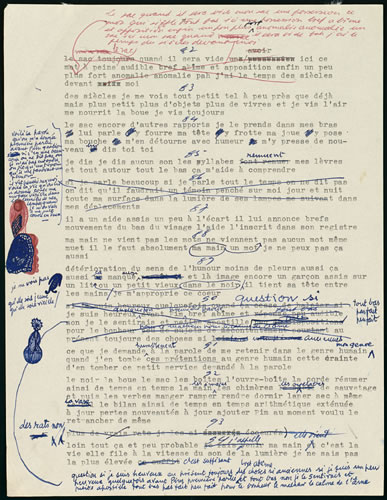
A manuscript

"How it is" written in 1961

01 May 2006

Isn't there anyone on the air?

Beckett at 100

«Today is the day we have been waiting for, even though it is better not to wait, because always what you get is less than what you hoped. 100 years since Samuel Beckett's birth. (Yes yes, they shall all now scream, "Birth was the death of him.")
"I once knew a madman who thought the end of the world had come. He was a painter--and engraver. I had a great fondness for him. I used to go and see him, in the asylum. I'd take him by the hand and drag him to the window. Look! There! All that rising corn! And there! Look! The sails of the herring fleet! All that loveliness!

(Pause.)

He'd snatch away his hand and go back into his corner. Appalled. All he had seen was ashes.
" (Endgame)
The thing is, Beckett makes me laugh. That's why I've stuck with him. Yes, there's bleakness and dreariness and the-world-is-awful and all that, but before there is that there is laughter. A sad laughter, yes, but that just makes it more meaningful and complex.

Before the laughter, there is language. That's what caused my first crush. It was "Happy Days", and yes they were -- high school, my head blown off. It took me forever to read the play. People were allowed to write like this? ("Embedded up to her waist in exact center of mound, WINNIE.") I couldn't make head or tail or kneecap of it. I wanted to know more. Who gave insane people pens to write with? Who published them? From the library, I took a copy of Waiting for Godot. I don't remember making much of it, but I do remember reading it entranced. Something in the rhythms.
"ESTRAGON:
Let's hang ourselves immediately!
VLADIMIR:
From a bough?
(They go towards the tree.)
I wouldn't trust it.
ESTRAGON:
We can always try.
VLADIMIR:
Go ahead.
ESTRAGON:
After you.
VLADIMIR:
No no, you first.
ESTRAGON:
Why me?
VLADIMIR:
You're lighter than I am.
ESTRAGON:
Just so!
VLADIMIR:
I don't understand.
ESTRAGON:
Use your intelligence, can't you?
(Vladimir uses his intelligence.)
VLADIMIR:
(finally).
I remain in the dark.
"
I couldn't stop. I read all the plays. They fit in one book and feel like a shelf. I haven't stopped reading. Now I have a case.

Eventually, I discovered the prose. Where? How? I don't remember. It took me a while. I still haven't finished Watt, fun as it is. With the prose, I tend to like it shorter -- the sublime How It Is and Texts for Nothing are particular favorites.
"Intent on these horizons I do not feel myfatiguee it is manifest none the less passage more laborious from one side to the other one semi-side prolongation of intermediate procumbency multiplication of mute imprecations

sudden quasi-certitude that another inch and I fall headlong into a ravine or dash myself against a wall though nothing I know only too well to be hoped for in that quarter this tears me from my reverie I've arrived
"
(How It Is)
Closest to my heart, though, is Endgame, perhaps because I once directed it (with high school students! Yes, I'm insane! But it turned out well, despite the odds.) and so I have lived with that text most closely. I find myself using phrases from it suddenly in everyday moments ("We'd need a proper wheel-chair. With big wheels. Bicycle wheels!"). It's an interesting enough play to read, but it's when you're in the midst of a production of it that the wonder of Beckett becomes most apparent, because the words become, somehow, living things -- not so much fragments shored against the ruins, but the magnificence of the ruins themselves, the words adorning the death of everything, an apotheosis in words, the last things left, the only things we can still apprehend after the speaker or writer is gone.
"I open the door of the cell and go. I am so bowed I only see my feet, if I open my eyes, and between my legs a little trail of black dust. I say to myself that the earth is extinguished, though I never saw it lit."
(Endgame)»

Published in The Mumpsimus - 13 April 2006

28 April 2006

Memories are killing

«So you must not think of certain things, of those that are dear to you, or rather you must think of them, for if you don't there is the danger of finding them, in your mind, little by little. That is to say, you must think of them for a while, a good while, everyday several times a day, until they sink forever in the mud. That's an order.»
in "The Expelled" (1954)

27 April 2006

A blank target

«KEN JORDAN: How did you first hear of Waiting for Godot?
BARNEY ROSSET: Sylvia Beach, who was Joyce's publisher in Paris and the owner of the Shakespeare and Co. bookstore, called me. She knew about Grove, one way or another, and she thought maybe we would like to publish Godot. I admired her very much; I was really struck by her effort, and she bolstered my involvement with the play a great deal. Beckett had already been turned down by Simon & Schuster. All of the established publishers would have had a much better chance of doing Beckett than Grove, right? They could have paid five times as much, but nobody wanted it. Nobody was interested.The same was true of Ionesco. The Bald Soprano was put on in Paris and got a lot of attention. Don Allen, who was important editor at Grove in the beginning, liked Ionesco very early. Beckett and Ionesco were on the scene together. They liked each other. I never heard one say anything bad about the other. At a much later date, I think Ionesco became jealous because he never achieved the same level of acclaim as Beckett … and he became a nasty son of a bitch, very reactionary as he got older. But they did admire each other. You have to remember that they both wrote in French, though neither one had French as his native language. Both were not young men when they started to get recognition. Both were struggling to make it in the theatre, blasting away at the existing structure.
KJ: Do you remember when you met Beckett?
BR: I remember the exact moment. It was in the bar of the Pont Royal Hotel, which is next door to Gallimard. And at that time Sartre hung out there, as did Camus, and so on. I was with Loly, my wife at the time, and we were to meet Beckett at six for a drink. This very handsome walked in wearing a raincoat and said, "Hi, nice to meet you. I've only got forty minutes." He was all set to get rid of us! At four that morning he was buying us champagne.
KJ: So you hit it off well.
BR: Right away. He was so gentle and charming. Kind.
KJ: Beckett was extremely loyal to Grove Press, and you became close friends. How did Beckett feel about the other books that Grove published - writers like the Beats, Henry Miller?
BR: I took him to lunch with Henry Miller after we won the Tropic of Cancer verdict in Chicago. They had known each other from the thirties; they did not like each other. Everything that you read about these two would tell you that they were not easy people to get along with. But when I brought them together, each of them told me afterwards, "Boy, has he changed! He's so nice now." I don't know what Beckett thought about Miller's writing. In one of his early letters he asked if I had read J. D. Salinger's Catcher in the Rye. He said he really liked it. William Burroughs was a writer he particularly didn't understand. There is a famous anecdote about a meeting between Burroughs and Beckett, which took place in Maurice Girodias's restaurant. I remember sitting next to Sam, while Burroughs, who worshipped Beckett, was explaining to him how you do cut-ups. Beckett said to Bill, "That's not writing, that's plumbing." Allen Ginsberg and Burroughs were very unusual in the sense that they understood that Beckett was very important at that time. They wanted him, almost desperately, to recognize them, and he just didn't seem to connect. It wasn't dislike, it was just … non-togetherness. He just didn't get it. If he had read anything of Burroughs before he started doing the cut-ups maybe he'd have gotten it But the Beats didn't impinge upon his consciousness. Trocchi did. Anything of Alex Trocchi's.
KJ: When you published Godot you couldn't have thought of it as a potentially popular title.
BR: We only printed something like a thousand copies, and the first year it sold about four hundred. It wasn't until the play was produced on Broadway a couple of years later - with Bert Lahr playing Estragon - that the book started to sell, though the production only lasted six weeks in New York. The audience walked out and Walter Winchell denounced it as the new Communist propaganda. But that production made it famous.
KJ: How many copies of Godot did Grove end up selling?
BR: Well over two million.»
From an interview with Barney Rosset, founder of Grove Press, by Ken Jordan in the Winter 1997-1998 issue of The Paris Review.

26 April 2006

A Television Play

Eh Joe (1969)

«Joe, late fifties, grey hair, old dressing-gown, carpet slippers, in his room.
1. Joe seen from behind sitting on edge of bed, intent pose, getting up, going to window, opening window, looking out, closing window, drawing curtain, standing intent.
2. Joe do. (from behind) going from window to door, opening door, looking out, closing door, locking door, drawing hanging before door, standing intent.
3. Joe do. Going from door to cupboard, opening cupboard, looking in, closing cupboard, locking cupboard, drawing hanging before cupboard, standing intent.
4. Joe do. Going from cupboard to bed, kneeling down, looking under bed, getting up, sitting down on edge of bed as when discovered, beginning to relax.
5. Joe seen from front sitting on edge of bed, relaxed, eyes closed. Hold, then dolly slowly in to closeup of face. First word of text stops this movement.

CAMERA:
Joe's opening movements followed by camera at constant remove, Joe full length in frame throughout. No need to record room as whole. After this opening pursuit, between first and final closeup of face, camera has nine slight moves in towards face, say four inches each time. Each move is stopped by voice resuming, never camera move and-voice together. This would give position of camera when dolly stopped by first word of text as one yard from maximum closeup of face, Camera does not move between paragraphs till clear that pause (say three seconds) longer than between phrases. Then four inches in say four seconds when movement stopped by voice resuming.

VOICE:
Low, distinct, remote, little colour, absolutely steady rhythm, slightly slower than normal. Between phrases a beat of one second at least. Between paragraphs about seven, i.e., three before camera starts to advance and four for advance before it is stopped by voice resuming.

FACE:
Practically motionless throughout, eyes unblinking during paragraphs, impassive except in so far as it reflects mounting tension of listening. Brief zones of relaxation between paragraphs when perhaps voice has relented for the evening and intentness may relax variously till restored by voice resuming.

...
WOMAN'S VOICE:
Joe ...
(Eyes open, resumption of intentness.)
Joe ...
(Full intentness.)
Thought of everything? ... Forgotten nothing? ... You're all right now, eh? ... No one can see you now ... No one can get at you now ... Why don't you put out that light? ... There might be a louse watching you ...Why don't you go to bed? ... What's wrong with that bed, Joe? ... You changed it, didn't you? ... Made no difference? ... Or is the heart already? ... Crumbles when you lie down in the dark ... Dry rotten at last ... Eh Joe?

[CAMERA MOVE 1]

The best's to come, you said, that last time . . . Hurrying me into my coat ... Last I was favoured with from you ... Say it you now, Joe, no one'll hear you ... Come on, Joe, no one can say it like you, say it again now and listen to yourself ... The best's to come ... You were right for once ... In the end.»

A+B=C

Do we suck? Do we rule? Tell us.

Lessnessless

«Lessness is a prose piece by Samuel Beckett in which he used random permutation to order sentences. Like interactive artworks, the piece is experienced as a process that depends upon the participant’s attempts to comprehend and create meaning. Although Lessness is linear prose, its orderly disorder sets up a non-linear reading process in which contradictory perspectives are viewed simultaneously. The piece comprises two of the approximately 8.3 x 1081 possible orderings of Beckett’s 60 sentences. The authors have developed a web site that generates versions of Lessness, exploring the effects of the capabilities of computing in the creation and exploration of art.»
from "Lessness: Randomness, Consciousness and Meaning" a paper written by Mads Haahr and Elizabeth Drew.

Damn it

«I am out on leave. Thrown out on leave.
Back to time, they said, for 24 hours.
Oh my God, I said, not that.
Slip into on this shroud, they said, lest you catch your death
of cold again.
Certainly not, I said.
This cap, they said, for your deaths head skull.
Definitely not, I said.
The New World outlet, they said, in the state of Ohio.
We cannot be more precise. Pause.
Proceed straight to Lima the nearest campus, they said,
and address them.
Address whom? I said.
The students, they said, and professors.
Oh my God, I said, not that.
Do not overstay your leave, they said,
if you do not wish it to be extended.
Pause.
What am I to say? I said.
Be yourself, they said, you're yourself.
Myself? I said. What are you insinuating?
Yourself before, they said.
Pause.
And after.
Pause.
Not during? I said.»
Early monologue of "Ohio Impromptu", a dramatic fragment that was later abandoned.

25 April 2006

Synopsis

Ohio Impromptu

Two identical black clad characters with long grey hair (a Reader and a Listener) sit at a table. The Reader reads from a small book (described as "a sad tale"), and the listener, never speaking, prompts him to stop, start and repeat with knocking on the table. The play ends when the Reader finds that there is "no more to tell" from the book.

Ohio Impromptu is a short play by Samuel Beckectt. Written in English in 1980, it began as a favour to Stan Gontarski, who requested a dramatic piece to be performed at an academic symposium in Columbus, Ohio in honour of Beckett’s seventy-fifth birthday. Beckett hesitantly agreed and began work on the play at the end of March and the first week of April, 1980.

24 April 2006

Wizard of us

An evening with endless power to irritate
Dominic Cavendish reviews Endgame at Barbican
«An accusation often levelled at Samuel Beckett is that he was too controlling. His stage directions are profuse and precise - glaring deviations from them were frowned on in his lifetime and, since his death, have sometimes met with a punitive response from his estate. But you come away from Charles Sturridge's grimly underwhelming revival of Endgame wondering whether Beckett wasn't exacting enough. Perhaps he should also have stipulated the optimum height for his actors.

I say this because Sturridge has cast a very short American actor, Peter Dinklage - with whom he worked on his recent film remake of Lassie - as Clov, the servant and sidekick of the blind, sedentary Hamm. The politically incorrect term would be "midget" - but, given that Sturridge exploits Dinklage's diminutive stature in order to enhance the play's tragi-comic effect, there is no reason to refrain from using it here.

While it is nice that showbiz-orientated dwarfs have more to look forward to these days than being fired out of cannons, the sad truth is that Dinklage isn't cut out for such a big role.

The comic gains are slight. Now the reason why Clov must amble back and forth with a ladder to survey the apocalyptic landscape outside the pair's joyless cell is not because the windows are too high up, but because he's too low down. Tee-hee.

Whenever he is mute, the actor does carry added pathos about his person, but Dinklage's approach to Beckett's badinage is so stilted that not only does all sense of familiarity between him and his cantankerous master evaporate, but also the lyricism of the writing dwindles before our ears.

Marooned on the other side of the double act, Kenneth Cranham's chair-bound, tramp-like Hamm doesn't distinguish himself much either, stuck in the rut of a rasping monotone. Two unmoving supporting performances from Tom Hickey and Georgina Hale as the spectral, dustbin-bound Nagg and Nell - the original "white trash", if you will - add to the evening's power to irritate.

Eileen Diss's deliberately flimsy-looking set stresses the theatrical in-jokery of the script, but the usual laughs prompted by lines such as "Will this never finish?" die in the throat here. The pain and despair of the quartet's terminal situation never bites, only the interminable ennui. Coming so soon after Michael Gambon and Lee Evans's stupendous account in the West End, this is a life-sapping disappointment.»
Published in the Telegraph - 24 Apr 2006

Beware the sky

«One night as he sat at his table head on hands he saw himself rise and go. One night or day. For when his own light went out he was not left in the dark. Light of a kind came from the one high window. Under it still the stool on which till he could or would no more he used to mount to see the sky. Why he did not crane out to see what lay beneath was perhaps because the window was not made to open or because he could or would not open it. Perhaps he knew only too well what lay beneath and did not wish to see it again. So he would simply stand there high above the earth and see through the clouded pane the cloudless sky. Its faint unchanging light unlike any light he could remember from the days and nights when day followed hard on night and night on day. This outer light then when his own went out became his only light till it in its turn went out and left him in the dark. Till it in its turn went out.»
in "Stirrings Still" (1988)

21 April 2006

Featuring across


Beckett Centenary Festival 2006 • Gate Theatre - BarbicanbiteDublin / London

Killed by inches down by fire

«Here all is clear. No, all is not clear. But the discourse must go on. So one invents obscurities. Rhetoric. These lights, for instance (which I do not require to mean anything): what is there so strange about them, so wrong? Is it their irregularity, their instability, their shining strong one minute and weak the next, but never beyond the power of one or two candles? Malone appears and disappears with the punctuality of clockwork, always at the same remove, the same velocity, in the same direction, the same attitude. But the play of the lights is truly unpredictable. It is only fair to say that to eyes less knowing than mine they would probably pass unseen. But even to mine do they not sometimes do so? They are perhaps unwavering and fixed, and my fitful perceiving the cause of their inconstancy.»
in "The Unnamable" (1958)

20 April 2006

Da Tagte Es

«redeem the surrogate goodbyes
the sheet astream in your hand
who have no more for the land
and the glass unmisted above your eyes»
in "Echo's Bones" (1935)

Can't get there from here

«WORSTWARD HO, by Samuel Beckett (Grove; $8.95). These forty-one small pages of very large type extend Beckett's wrestle with the void to the point where less would be nothing. A personless voice, uttering words of mostly one syllable in sentences of rarely more than five words, urges itself onward in a dim but resistant realm where humanoid apparitions fragmentarily loom and then fade. "So leastward on. So long as dim still. Dim undimmed. Or dimmed to dimmer still. To dimmost dim. Leastmost in dimmost dim. Unworsenable worst." The dim shapes in this environment most minimal are called shades, and we probably would not be entirely wrong to think of it as an old-fashioned Hades that ends in new-style entropy. ("Vast apart. At bounds of boundless void. Whence no farther.") A sterile, dreadful exercise, it might be said, and one does not, as Dr. Johnson remarked of "Paradise Lost", wish it's longer than it is. And yet, the words—"How almost true they sometimes almost ring! How wanting in inanity!"
Review in The New Yorker, March 1984

19 April 2006

Shoulder blades

«"Damned to Fame" is not the first life of Beckett, of course. Notably, there was Deirdre Bair's 1978 biography, which drew on many letters she had discovered from Beckett to his friend Tom MacGreevy. They dispel the notion of Beckett as a philosophical recluse and show him as a man whose troubles shaped his writing. Mr. Knowlson has had full access to the MacGreevy letters, unlike Ms. Bair, and to six notebooks reporting Beckett's mind-altering trip through Germany in 1936-37. He added dozens of other sources. Beckett died six months after Mr. Knowlson began his work (he retired as a professor of French at the University of Reading in England to take it on). For five months, in brief visits, they discussed his life. Mr. Knowlson's presentation of these materials is academically invaluable. Much more important, he has composed a remarkable portrait of an impressive man. "Damned to Fame" is a magnificent biography.

Beckett's writings hold their audience because they are emotionally intense and disturbing. They are also richly allusive, evocative of literature, art, music, philosophy and psychology. Mr. Knowlson speaks authoritatively about these matters, without ostentation. He gives credit unstintingly; he even mentions me once.

The biography, though sadly shortened from the manuscript, is enlivened by suggestive details. Examples: Beckett's maternal grandmother rebuked a granddaughter who loved chocolates. "You shouldn't love something to eat, my dear. You should only love God." His uncle Gerald Beckett, rather different, called life "a disease of matter." When Beckett's father died, Gerald comforted the widow: "Well, May, he's got it over. What is it all about, in the end, for us all, from the cry go, but get it over?"

Such anecdotes bring alive decades of Beckett's public accomplishments and private doubts, regrets and illness. Mr. Knowlson modestly claims to have found new materials in three areas: "music and art", Beckett's political activities and Beckett's character. Readers will find much more.

Beckett's lifelong absorption in classical music (he was a competent pianist) and his concern for the verbal music of his own writings are matched by his knowledge of art: "He could spend as much as an hour in front of a single painting (...) savoring its forms and its colors, reading it, absorbing its minutest detail." Mr. Knowlson also shows how Beckett's dramatic scenes, figures, gestures and lighting echo these artworks.

The German diaries record Beckett's many meetings with painters, and discussions of paintings. They also convey his distaste for Germany's increasing anti-Semitism and censorship and Hitler's long, shrill speeches.

That topic prepares us for Beckett's activities with a French Resistance group and with the Irish Red Cross in France after World War II. In this grim work he displayed "astonishing powers of concentration, a meticulous attention to detail", Mr. Knowlson says; he could "organize, reduce and sift very diffuse material so as to make it succinct and intelligible." Those qualities recur in his writings. Additionally, "sheer obstinacy (...) was, he commented himself, a constant trait in his character."

That difficult, variable character is Mr. Knowlson's major theme. He describes a model of upper-class Protestant gentility: the 4-year-old praying; the youth playing golf, tennis, rugby and cricket, swimming, boxing, running track and racing motorcycles; and the college student who neither smoked nor drank.

But higher education puts at risk conventional faiths and values: "On the key issue of pain, suffering and death (...) Beckett's religious faith faltered and quickly foundered." A sermon in which a Canon Dobbs said that the only thing he could tell the suffering, dying and bereaved was, "The Crucifixion was only the beginning. You must contribute to the kitty", shook Beckett. So did Dobbs's advice to the unhappy: "When it's morning, wish for evening. When it's evening, wish for morning." Adding Baudelaire, Beckett sharpened that idea in "Endgame": "You cried for night; it falls: now cry in darkness."

Beckett discovered Dante and recent French writers at Trinity College, Dublin. He won an appointment to the Ecole Normale Superieure in Paris, met James Joyce and published a monograph on Proust. His career was under way. But this flawed summary evades the harshness of his writings.

Here Mr. Knowlson is especially valuable, providing persuasive detail. The young Beckett was an arrogant and withdrawn brat: "He confessed later to feelings of superiority and contempt, which led to a depression that came to seem (...) 'morbid.'" Teaching at Trinity, he met his like among colleagues. "Scholarly wit and sarcasm", Mr. Knowlson says, "sounded all too often like exhibitionism, bitchiness and character assassination." As for creativity: "How can one write here", Beckett complained, "when every day vulgarizes one's hostility and turns anger into irritation and petulance?"

Those perceptions, and psychosomatic illnesses, led to painful psychological insight. Beckett abandoned teaching and entered therapy after his father's death in 1933. Mr. Knowlson is eloquent about the effects of that death. The therapy lasted about six months, Beckett told him. (He once told me three.) "In reality his treatment lasted nearly two years", Mr. Knowlson says.

What Beckett would not tell him he had written to MacGreevy. In March 1935, after some 150 sessions, he wrote an amazing letter. With bitterness and detachment he summarized what he now knew about his illness. Mr. Knowlson specifies its causes: "the intensity of his mother's attachment to him and his powerful love-hate bond with her." Later, fleeing his mother and Ireland after a dreadful quarrel, Beckett offered MacGreevy a memorable phrase: "I am what her savage loving has made me."

Accurate analysis is not therapy. The relationship and its effects continued. Even in his last months, Mr. Knowlson says, "Beckett's feelings of love for his mother and remorse at having, as he saw it, let her down so frequently, struck me as still intense, almost volcanic." About his remarkable wife, Suzanne, who died some months earlier than he, he suffered similar guilt and remorse.

But that hard-won knowledge of his psyche had altered him. Mr. Knowlson describes his letter of self-analysis as "the first convincing explanation of how the arrogant, disturbed, narcissistic young man (...) evolved into someone who was noted later for his extraordinary kindness, courtesy, concern, generosity and almost saintly 'good works.'"

Beckett's outer world is not neglected, although space limitations restrict discussion of the trilogy of novels, "almost certainly the most enduring works that Beckett wrote." Mr. Knowlson is insightful about the plays and detailed about their performances. A playwright gives hostages to fortune. We hear of many misfortunes and some near misses, especially with "Godot." Imagine Buster Keaton as Vladimir and Marlon Brando as Estragon.

The inner world persists. Beckett remains painfully aware of his faults, unable to mend them and struggling to compensate for them, as Mr. Knowlson guides us through the powerful writings in which he dramatized the blackness in his psyche.

Beckett becomes his own finest character. Mr. Knowlson is with him to the final curtain, unblinking: "Beckett became frailer and thinner. His hands were now noticeably distorted. (...) Greeting him with a fond embrace, you noticed how prominent his shoulder blades felt (...) and how thin his wrists and forearms had become.'' Born on Good Friday, April 13, 1906, he died on Friday, Dec. 22, 1989.

What is the meaning of this complicated life? Mr. Knowlson reports discussing with Beckett his brief autobiographical novel "Company": "We laughed uproariously at the idea of reaching 'truth' in so shifty an area as a human life." Weeks before he died, William Butler Yeats wrote: "When I try to put it all into a phrase I say, 'Man can embody truth but he cannot know it.' I must embody it in the completion of my life." "Damned to Fame" splendidly preserves the truths embodied in Beckett's life.»
published in The New York Times, Aug. 3, 1997.