«No trace anywhere of life, you say, pah, no difficulty there, imagination not dead yet, yes, dead, good, imagination dead imagine. Islands, waters, azure, verdure, one glimpse and vanished, endlessly, omit. Till all white in the whiteness the rotunda. No way in, go in, measure. Diameter three feet, three feet from ground to summit of the vault. Two diameters at right angles AB CD divide the white ground into two semicircles ACB BDA. Lying on the ground two white bodies, each in its semicircle. White too the vault and the round wall eighteen inches high from which it springs. Go back out, a plain rotunda, all white in the whiteness, go back in, rap, solid throughout, a ring as in the imagination the ring of bone. The light that makes all so white no visible source, all shines with the same white shine, ground, wall, vault, bodies, no shadow. Strong heat, surfaces hot but not burning to the touch, bodies sweating. Go back out, move back, the little fabric vanishes, ascend, it vanishes, all white in the whiteness, descend, go back in. Emptiness, silence, heat, whiteness, wait, the light goes down, all grows dark together, ground, wall, vault, bodies, say twenty seconds, all the greys, the light goes out, all vanishes. At the same time the temperature goes down, to reach its minimum, say freezing-point, at the same instant that the black is reached, which may seem strange. Wait, more or less long, light and heat come back, all grows white and hot together, ground, wall ,vault, bodies, say twenty seconds, all the greys, till the initial level is reached when the fall began. More or less long, for there may intervene, experience shows, between end of fall and beginning of rise, pauses of varying length, from the fraction of the second to what would have seemed, in other times, other places, an eternity.»
in "Imagination Dead Imagine"
18 April 2006


17 April 2006
Inhale
"BREATH"
[CURTAIN]
1. Faint light on stage littered with miscellaneous rubbish. Hold about
five seconds.
2. Faint brief cry and immediately inspiration and slow increase of light
together reaching maximum together in about ten seconds. Silence and
hold for about five seconds.
3. Expiration and slow decrease of light together reaching minimum
together (light as in 1) in about ten seconds and immediately cry as
before. Silence and hold about five seconds.
[CURTAIN]
RUBBISH
No verticals, all scattered and lying.
CRY
Instant of recorded vagitus. Important that two cries be identical,
switching on and off strictly synchronized light and breath.
BREATH
Amplified recording.
MAXIMUM LIGHT
Not bright. If 0 = dark and 10 = bright, light should move from about
3 to 6 and back.
[CURTAIN]
1. Faint light on stage littered with miscellaneous rubbish. Hold about
five seconds.
2. Faint brief cry and immediately inspiration and slow increase of light
together reaching maximum together in about ten seconds. Silence and
hold for about five seconds.
3. Expiration and slow decrease of light together reaching minimum
together (light as in 1) in about ten seconds and immediately cry as
before. Silence and hold about five seconds.
[CURTAIN]
RUBBISH
No verticals, all scattered and lying.
CRY
Instant of recorded vagitus. Important that two cries be identical,
switching on and off strictly synchronized light and breath.
BREATH
Amplified recording.
MAXIMUM LIGHT
Not bright. If 0 = dark and 10 = bright, light should move from about
3 to 6 and back.
Open your mouth
Londoners gasp at Beckett's 35-second play
By Paul Keller - LONDON, Feb 11, 99 (Reuters)
«To admirers, a play that has no actors, just a stage littered with rubbish and takes 35 seconds to perform is a sardonic comment on the brevity of life.
To others, it's a pretentious piece of nonsense.
The play in question, "Breath", is making its London West End debut. It was written by the late avant-garde Irish playwright and Nobel prize winner Samuel Beckett.
Beckett's reputation doesn't matter a jot to the play's detractors. The enigmatic quality of one of the world's shortest dramatic performances simply enrages some.
"I just want to put on record that I thought the whole evening was completely bogus and pretentious," was one spectator's view.
The rarely staged piece features in a double bill with a 45-minute Beckett play, "Krapp's Last Tape", at the Arts Theatre, a small playhouse in London's theatreland.
That the play is controversial should be no surprise. Beckett's austere, tragi-comic works are notorious for dividing critical opinion and for flouting the theatrical conventions of time, plot and character.
When "Waiting for Godot" was first staged nearly 50 years ago, critics ridiculed the story of two tramps who do nothing but hang about and bicker. It went on to achieve international fame and has been translated into
several languages. It regularly features in critics' lists of plays of the century.
35 SECONDS LONG -- WHAT ELSE WOULD WE BE DOING?
The stage directions for "Breath" occupy a single page and take longer to read than the performing of them.
A stage strewn with debris becomes visible in a light that starts as faint, becomes less faint then fades again.
Simultaneously the audience hears a faint cry, what Beckett calls an "instant of recorded vagitus", then the sound of a human breath, followed by another faint cry as the lights fade and the curtain falls. Blink and you'd miss it.
"It's all very well to read about "Breath" but I thought it'd be fascinating to see what it actually amounts to," said Edward Petherbridge, a veteran British actor responsible for bringing "Breath" to London after an international tour.
Written in 1969, the play is viewed as something of a theatrical novelty. Its appeal is usually reckoned to be restricted to die-hard Beckett aficionados and theatre directors with a taste for the bizarre.
"I thought there might be a few people in London who might like to see it. And I was right there are a few people," he quips, referring to the less than sell-out appeal Beckett's ultra-minimalist play has had for
London theatre goers.
The play is backed by the Royal Shakespeare Company (RSC), one of Britain's top theatre companies. Persuading the RSC to put it on was no pushover either, Petherbridge recalls.
"I remember when some of us started to lose our nerve about it and wondered whether it was really worth doing, I heard myself saying that it was a very good play, it only takes 35 seconds to run -- What else would
we be doing?"
BECKETT AND THE NAKED BODIES
Audience reaction to "Breath" ranges between respectful silence and uncontrollable mirth, says Petherbridge who is unrepentant about stageing the play.
"It seemed a chance to put it on. There are not that many. After all you can't imagine coming just to see it."
Petherbridge says people find "Breath" quietly affecting and, like other Beckett plays, the imagery oddly haunting.
The two-act play "Happy Days" has a woman buried up to her waist, then up to her neck, in sand; another play has two characters living in dustbins; while a lone, disembodied mouth is the focus of a disturbing monologue called "Not I".
"Breath" achieved uninvited notoriety 30 years ago when top British theatre critic Kenneth Tynan asked Beckett for a contribution to his bawdy London revue "Oh Calcutta!"
Tynan included "Breath" in the revue but with one crucial amendment -- naked bodies were added to the rubbish as the play's props. Beckett was reported to be appalled, especially as the revue's programme attributed the work to him.
"So this is the first London production of "Breath" in its purest form," says Petherbridge.
In its sparse, inexplicable form, "Breath", superficially at least, seems to sum up a writer who loathed the limelight and avoided explaining the meaning of his work.
Even when awarded the Nobel Literature Prize in 1969, Beckett stayed at home. He never gave press interviews.»
By Paul Keller - LONDON, Feb 11, 99 (Reuters)
«To admirers, a play that has no actors, just a stage littered with rubbish and takes 35 seconds to perform is a sardonic comment on the brevity of life.
To others, it's a pretentious piece of nonsense.
The play in question, "Breath", is making its London West End debut. It was written by the late avant-garde Irish playwright and Nobel prize winner Samuel Beckett.
Beckett's reputation doesn't matter a jot to the play's detractors. The enigmatic quality of one of the world's shortest dramatic performances simply enrages some.
"I just want to put on record that I thought the whole evening was completely bogus and pretentious," was one spectator's view.
The rarely staged piece features in a double bill with a 45-minute Beckett play, "Krapp's Last Tape", at the Arts Theatre, a small playhouse in London's theatreland.
That the play is controversial should be no surprise. Beckett's austere, tragi-comic works are notorious for dividing critical opinion and for flouting the theatrical conventions of time, plot and character.
When "Waiting for Godot" was first staged nearly 50 years ago, critics ridiculed the story of two tramps who do nothing but hang about and bicker. It went on to achieve international fame and has been translated into
several languages. It regularly features in critics' lists of plays of the century.
35 SECONDS LONG -- WHAT ELSE WOULD WE BE DOING?
The stage directions for "Breath" occupy a single page and take longer to read than the performing of them.
A stage strewn with debris becomes visible in a light that starts as faint, becomes less faint then fades again.
Simultaneously the audience hears a faint cry, what Beckett calls an "instant of recorded vagitus", then the sound of a human breath, followed by another faint cry as the lights fade and the curtain falls. Blink and you'd miss it.
"It's all very well to read about "Breath" but I thought it'd be fascinating to see what it actually amounts to," said Edward Petherbridge, a veteran British actor responsible for bringing "Breath" to London after an international tour.
Written in 1969, the play is viewed as something of a theatrical novelty. Its appeal is usually reckoned to be restricted to die-hard Beckett aficionados and theatre directors with a taste for the bizarre.
"I thought there might be a few people in London who might like to see it. And I was right there are a few people," he quips, referring to the less than sell-out appeal Beckett's ultra-minimalist play has had for
London theatre goers.
The play is backed by the Royal Shakespeare Company (RSC), one of Britain's top theatre companies. Persuading the RSC to put it on was no pushover either, Petherbridge recalls.
"I remember when some of us started to lose our nerve about it and wondered whether it was really worth doing, I heard myself saying that it was a very good play, it only takes 35 seconds to run -- What else would
we be doing?"
BECKETT AND THE NAKED BODIES
Audience reaction to "Breath" ranges between respectful silence and uncontrollable mirth, says Petherbridge who is unrepentant about stageing the play.
"It seemed a chance to put it on. There are not that many. After all you can't imagine coming just to see it."
Petherbridge says people find "Breath" quietly affecting and, like other Beckett plays, the imagery oddly haunting.
The two-act play "Happy Days" has a woman buried up to her waist, then up to her neck, in sand; another play has two characters living in dustbins; while a lone, disembodied mouth is the focus of a disturbing monologue called "Not I".
"Breath" achieved uninvited notoriety 30 years ago when top British theatre critic Kenneth Tynan asked Beckett for a contribution to his bawdy London revue "Oh Calcutta!"
Tynan included "Breath" in the revue but with one crucial amendment -- naked bodies were added to the rubbish as the play's props. Beckett was reported to be appalled, especially as the revue's programme attributed the work to him.
"So this is the first London production of "Breath" in its purest form," says Petherbridge.
In its sparse, inexplicable form, "Breath", superficially at least, seems to sum up a writer who loathed the limelight and avoided explaining the meaning of his work.
Even when awarded the Nobel Literature Prize in 1969, Beckett stayed at home. He never gave press interviews.»
Room 604
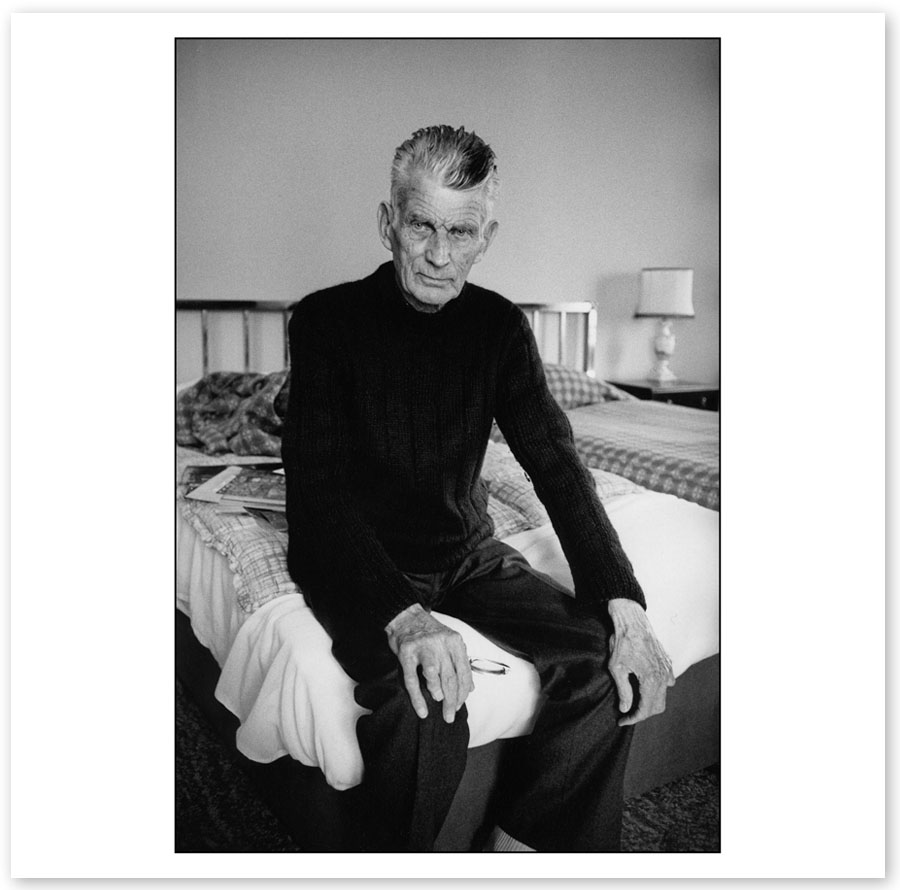
Seated in Room 604, The Hyde Park Hotel, London, 1980 / © John Minihan
INSTRUCTIONS: Print this photo with the size of the building in front of you. Take a great portion of glue and go to the roof of the structure. Roll down the photo. With the help of some climbing ropes go down slowly and strain the paper against the windows and walls of the building. Spread the glue evenly. Come down safely.
Take a photo and send it to us.
RUN!
Included for company
«...and having heard that when a man in a forest thinks he is going in a straight line, in reality he is going in a circle, I did my best to go in a circle, hoping in this way to go in a straight line. For I stopped being half-witted and became sly, whenever I took the trouble. And my head was a storehouse of useful knowledge. And if I did not go in a rigorously straight line, with my system of going in a circle, at least I did not go in a circle, and that was something.»
in "Molloy" [1955]
in "Molloy" [1955]
Glimpse over
"WHAT IS THE WORD"
for Joe Chaikin
«folly -
folly for to -
for to -
what is the word -
folly from this -
all this -
folly from all this -
given -
folly given all this -
seeing -
folly seeing all this -
this -
what is the word -
this this -
this this here -
all this this here -
folly given all this -
seeing -
folly seeing all this this here -
for to -
what is the word -
see -
glimpse -
seem to glimpse -
need to seem to glimpse -
folly for to need to seem to glimpse -
what -
what is the word -
and where -
folly for to need to seem to glimpse what where -
where -
what is the word -
there -
over there -
away over there -
afar -
afar away over there -
afaint -
afaint afar away over there what -
what -
what is the word -
seeing all this -
all this this -
all this this here -
folly for to see what -
glimpse -
seem to glimpse -
need to seem to glimpse -
afaint afar away over there what -
folly for to need to seem to glimpse afaint afar away over there what -
what -
what is the word -
what is the word»
[This was the very last work of Samuel Beckett, was written in bed in the nursing home where he spent the last period of his life in 1989, the year of his death, and was published in 1990. The soundly silence of his words was never so well achieved like in this text. We can feel the tempest of all his life coming from our mouths when we read it aloud.]
for Joe Chaikin
«folly -
folly for to -
for to -
what is the word -
folly from this -
all this -
folly from all this -
given -
folly given all this -
seeing -
folly seeing all this -
this -
what is the word -
this this -
this this here -
all this this here -
folly given all this -
seeing -
folly seeing all this this here -
for to -
what is the word -
see -
glimpse -
seem to glimpse -
need to seem to glimpse -
folly for to need to seem to glimpse -
what -
what is the word -
and where -
folly for to need to seem to glimpse what where -
where -
what is the word -
there -
over there -
away over there -
afar -
afar away over there -
afaint -
afaint afar away over there what -
what -
what is the word -
seeing all this -
all this this -
all this this here -
folly for to see what -
glimpse -
seem to glimpse -
need to seem to glimpse -
afaint afar away over there what -
folly for to need to seem to glimpse afaint afar away over there what -
what -
what is the word -
what is the word»
[This was the very last work of Samuel Beckett, was written in bed in the nursing home where he spent the last period of his life in 1989, the year of his death, and was published in 1990. The soundly silence of his words was never so well achieved like in this text. We can feel the tempest of all his life coming from our mouths when we read it aloud.]
Cause they don't know what's really real now
«In Paris, in January of 1938, while refusing the solicitations of a notorious pimp who ironically went by the name of Prudent, Beckett was stabbed in the chest and nearly killed. James Joyce arranged a private room for the injured Beckett at the hospital. The publicity surrounding the stabbing attracted the attention of Suzanne Descheveaux-Dumesnil, who knew Beckett slightly from his first stay in Paris; this time, however, the two would begin a lifelong companionship.
At a preliminary hearing, Beckett asked his attacker for the motive behind the stabbing, and Prudent casually replied, "Je ne sais pas, Monsieur. Je m'excuse" ("I do not know, sir. I'm sorry"). Beckett occasionally recounted the incident in jest, and eventually dropped the charges against his attacker—partially to avoid further formalities, but also because he found Prudent to be personally likable and well-mannered.»
from Wikipedia
At a preliminary hearing, Beckett asked his attacker for the motive behind the stabbing, and Prudent casually replied, "Je ne sais pas, Monsieur. Je m'excuse" ("I do not know, sir. I'm sorry"). Beckett occasionally recounted the incident in jest, and eventually dropped the charges against his attacker—partially to avoid further formalities, but also because he found Prudent to be personally likable and well-mannered.»
from Wikipedia
Beckett's Flu
«Here he stood. Here he sat. Here he knelt. Here he lay. Here he moved, to and fro, from the door to the window, from the window to the door; from the window to the door, from the door to the window; from the fire to the bed, from the bed to the fire; from the bed to the fire, from the fire to the bed; from the door to the fire, from the fire to the door; from the fire to the door, from the door to the fire; from the window to the bed, from the bed to the window; from the bed to the window, from the window to the bed; from the fire to the window, from the window to the fire; from the window to the fire, from the fire to the window; from the bed to the door, from the door to the bed; from the door to the bed, from the bed to the door; from the door to the window, from the window to the fire; from the fire to the window, from the window to the door; from the window to the door, from the door to the bed; from the bed to the door, from the door to the window; from the fire to the bed, from the bed to the window; from the window to the bed, from the bed to the fire; from the bed to the fire, from the fire to the door; from the door to the fire, from the fire to the bed; from the door to the window, from the window to the bed; from the bed to the window, from the window to the door; from the window to the door, from the door to the fire; from the fire to the door, from the door to the window; from the fire to the bed, from the bed to the door; from the door to the bed, from the bed to the fire; from the bed to the fire, from the fire to the window; from the window to the fire, from the fire to the bed; from the door to the fire, from the fire to the window; from the window to the fire, from the fire to the door; from the window to the bed, from the bed to the door; from the door to the bed, from the bed to the window; from the fire to the window, from the window to the bed; from the bed to the window, from the window to the fire; from the bed to the door, from the door to the fire; from the fire to the door, from the door to the bed...»
in "Watt" [Olympia Press, 1953]
in "Watt" [Olympia Press, 1953]
Instructions
Grab a Beckett's text (grab a Beckett's picture), mark it down, print it the size you want (or just print it as a reference). Or write it in a piece of paper or into a notebook. Take it outside, take it to the street. Find a nice spot. Any place, anywhere. Copy it to the wall, to the garment, to the ceiling (the sky). By hand, by stick it out, by pressure.
Run if needed.
Afterwards take a photo (make a movie!) and send it to us. We will publish it here.
SPREAD THE WORD!
Run if needed.
Afterwards take a photo (make a movie!) and send it to us. We will publish it here.
SPREAD THE WORD!
Always returning
«All known all white bare white body fixed one yard legs joined like sewn. Light heat white floor one square yard never seen. White walls one yard by two white ceiling one square yard never seen. Bare white body fixed only the eyes only just. Traces blurs light grey almost white on white. Hands hanging palms front white feet heels together right angle. Light heat white planes shining white bare white body fixed ping fixed elsewhere. Traces blurs signs no meaning light grey almost white. Bare white body fixed white on white invisible. Only the eyes only just light blue almost white. Head naught eyes light blue almost white silence within. Brief murmurs only just almost never all known. Traces blur signs no meaning light grey almost white. Legs joined like sewn heels together right angle. Traces alone uncover given black light grey almost white on white. Light heat white walls shining white one yard by two. Bare white body fixed one yard ping fixed elsewhere. Traces blurs signs no meaning light grey almost white...»
in "Ping"
in "Ping"
16 April 2006
My calculations of the world
«One day suddenly it dawned on me, dimly, that I might perhaps achieve my purpose without increasing the number of my pockets, or reducing the number of my stones, but simply by sacrificing the principle of trim.
The meaning of this illumination, which suddenly began to sing within me, like a verse of Isaiah, or of Jeremiah, I did not penetrate at once, and notably the word trim, which I had never met with, in this sense, long remained obscure. Finally I seemed to grasp that this word trim could not here mean anything else, anything better, than the distribution of the sixteen stones in four groups of four, one group in each pocket, and that it was my refusal to consider any distribution other than this that had vitiated my calculations until then and rendered the problem literally insoluble. And it was on the basis of this interpretation, whether right or wrong, that I finally reached a solution, inelegant assuredly, but sound, sound. Now I am willing to believe, indeed I firmly believe, that other solutions to this problem might have been found and indeed may still be found, no less sound, but much more elegant than the one I shall now describe, if I can...»
in "Molloy" [1955]
The meaning of this illumination, which suddenly began to sing within me, like a verse of Isaiah, or of Jeremiah, I did not penetrate at once, and notably the word trim, which I had never met with, in this sense, long remained obscure. Finally I seemed to grasp that this word trim could not here mean anything else, anything better, than the distribution of the sixteen stones in four groups of four, one group in each pocket, and that it was my refusal to consider any distribution other than this that had vitiated my calculations until then and rendered the problem literally insoluble. And it was on the basis of this interpretation, whether right or wrong, that I finally reached a solution, inelegant assuredly, but sound, sound. Now I am willing to believe, indeed I firmly believe, that other solutions to this problem might have been found and indeed may still be found, no less sound, but much more elegant than the one I shall now describe, if I can...»
in "Molloy" [1955]
15 April 2006
This is how it will be!
«I shall not be alone, in the beginning. (I am of course alone.) Alone. That is soon said. (Things have to be soon said.) And how can one be sure, in such darkness? I shall have company. In the beginning. A few puppets. Then I'll scatter them, to the winds, if I can.»
in "The Unnamable"
in "The Unnamable"
Subscribe to:
Posts (Atom)
